A nice interface I stumbled upon: the JabRef editor for smart groups:

an interface for a complex task. To explain the outcome, it generates a description of how the software now behaves. nice!
personal weblog of Leo Sauermann
A nice interface I stumbled upon: the JabRef editor for smart groups:
an interface for a complex task. To explain the outcome, it generates a description of how the software now behaves. nice!
A truly impressive and visionary speech, summing up why we do web 2.0. Must see Clay Shirky explaining what TV has grabbed for the last 50 years: our cognitive surplus. (of course, you all have already seen it, its from April 2008)
watch:
http://blip.tv/file/855937/
Excellent quotes (some literally, some only overlap in meaning, wasn’t quick enough to type everything)
(telling a story he experienced)…
TV Reporter: Where do people find all the time to do wikipedia?
Clay Shirky: No one who works in TV gets to ask that question.
You know where the times comes from. It comes from the cognitive surplus you have been masking for the last 50 years.
Warcraft: grown men sitting in their basement pretending to be elves.
At least they are doing something.
… the amount spent watching TV worldwide equals to creating 10.000 wikipedia projects each year…
a four year old daughter jumps up while watching a dvd.
She looks behind the TV fumbling through the cables, and we wondered… she said she is “looking for the mouse”
A screen that ships without a mouse ships broken.
many thanks to Gunnar Grimnes for sharing
Last week the NEPOMUK Social Semantic Desktop Summer School happened. A short summary.
First and most interesting, much material of the summer school is available in the wiki. Second, I uploaded a lot of pictures, and there are more on flickr tagged with nepomuksummerschool2008.
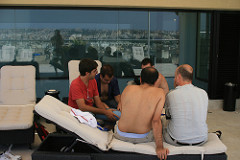
The students were great, and very capable. We had people from all over the world, to randomly pick three: Samur from Rio, Rigel from Chicago, Bernhard from Austria. Of course, as usual I had problems keeping the names and backgrounds :-/
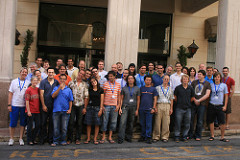
After three days of teaching and hands-on sessions, the students had to do their own projects. Two projects were winning, Chatomuk, a semantified chat-client with tag-cloud and other niceties, and a project showing user interface designs. Both are missing some documentation on the wiki, but Gunnar and Bernhard are working to make Chatomuk downloadable.
It was tricky to present the material in a short time and also involve the students in learning, we tried out different teaching methods (frontal presentation, pen&paper creation of ontologies, hands-on code, directing the students to google quickly for the right info), I hope it was a good mix for everyone.
The school also had a social event, and we organized opportunities for socialising every evening.

A very nice social event was hacking the mini projects on thursday night:
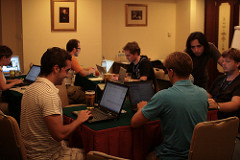
I talked to many people about the idea to create a product from nepomuk that could be so good that people will pay for it and it was interesting to see the possibilities and ideas how to do that.
Well, there were so many coffee breaks, chats, discussions, I can’t write much more but say:
thanks for all the participants for attending – blog it (and ping me)!
We just had a laugh when programming Lucene indexing for LuceneSail.
Tomasz was reading this code….
… for … HitIterator …
and was shocked because the first impression was Hitlerator. OMG, if there was a class Hitlerating everything… this would be an implementation of Godwin’s law.
I will be speaking at ESTC2008, on 25th September 2008 around 16:45 in the Rittersaal room.
The topics of my talk will be circling around Semantic Desktop, personalized Semantic Web, and how this is used or can be used in company settings
Recently, on 28.7.2008, the Semantic Web company published an interview with Corinna Barth about gender studies and the Semantic Web. I blogged about that.
Stefano Bertolo pointed out in a comment that CYC allows Microtheories and that this allows alternating views.
I asked Corinna about that and she helped me a lot by passing on a few pointers from her vast literature collection about CYC and gender studies, indicating that this fact is known and that she referenced a study by Alison Adam (1995, 1998). I will share the references with you, if you google for gender studies and Semantic Web, it may help you:
(updated on 10.9. based on more information)
as blogged in May, we organize a Summer School on the Semantic Desktop and the NEPOMUK project.
I arrived today in Malta, at 8 in the evening and sitting now together with the other organizers doing last-minute preparation tasks. The others were working all day already.
It is going to be a good week for us, a good moment in the project (NEPOMUK ends in December) and we can pass on a lot of information we learned to other PhD students to keep the ball rolling.
At the airport I met Bernhard Schandl from Vienna, who is part of the Web of data hands-on organization team (btw, sign up there! if the web-form is not online yet, send them a mail). We met before and had a nice chat, good start into the week.
Horray: Nepomuk and KDE to introduce the semantic desktop, an Article by Bruce Byfield on August 26, 2008 on Linux.com.
Read the article:
http://www.linux.com/feature/144853
Here is the beginning lines:
If you follow technology trends, you have probably heard of the semantic desktop — a data layer for annotating and sharing the information in your computer. But what you may not be aware of is that the semantic desktop is not a distant goal, but scheduled to arrive at the end of 2008. And, when it does, the idea will probably be implemented through the work done by the Nepomuk project, and, most likely, by KDE first.
Ansgar Bernardi, deputy head of the Knowledge Management Department at Deutsches Forschungszentrum für Künstliche Intelligenz (DFKI, or the German Research Center for Artificial Intelligence) and Nepomuk’s coordinator, explains, “The basic problem that we all face nowadays is how to handle vast amounts of information at a sensible rate.” According to Bernardi, Nepomuk takes a traditional approach by creating a meta-data layer with well-defined elements that services can be built upon to create and manipulate the information.
“The first idea of building the semantic desktop arose from the fact that one of our colleagues could not remember the girlfriends of his friends,” Bernard says, more than half-seriously. “Because they kept changing — you know how it is. The point is, you have a vast amount of information on your desktop, hidden in files, hidden in emails, hidden in the names and structures of your folders. Nepomuk gives a standard way to handle such information.”
I like the part about the forgetting colleague 😉
Well, now I at least remember the name of my wife….
Its good to be able to tell a story that connects to daily life problems, a seldom moment where a Semantic Web app solves a common problem 😉
For years we have been debating using xam.de’s “Issue Based Argumentation in a Wiki” IBAW. This technique allowed us to gather arguments for crucial decisions in the NEPOMUK project.
Now behold debategraph.org  .
.
Our goal is to make the best arguments on all sides of any debate freely available to all and continuously open to challenge and improvement by all … A wiki debate visualization tool.
Users can add pro/con arguments and deepen them with sub-arguments:

compare it with an IBAW example:
issue: our coffee machine is broken
* idea: fix it
* pro: cheap
* con: takes too much time, we can’t live so long without coffee
* idea: buy a new one
* pro: fast
* con: expensive
* issue: we need approval form our director
* idea: we collect money ourselves
A colleague of mine wanted to do a simple number comparison in Sesame2, and couldn’t make it out of the box. Because you may also want to query for “?blogposts nao:numericRating ?rating. FILTER (?rating > 8)”:
A whole query is:
SELECT ?blogpost ?rating WHERE {
?blogpost nao:numericRating ?rating.
FILTER (?rating >= ‘8’^^<http://www.w3.org/2001/XMLSchema#integer>) .
}
Thanks and kudos to Manuel Möller
What is NAO? An ontology used on the Semantic Desktop to rate things. So, if you give stars to something in KDE 4.0, its a NAO triple…