Gender Studies and Cyc Micro-Theories

Recently, on 28.7.2008, the Semantic Web company published an interview with Corinna Barth about gender studies and the Semantic Web. I blogged about that.

Stefano Bertolo pointed out in a comment that CYC allows Microtheories and that this allows alternating views.

I asked Corinna about that and she helped me a lot by passing on a few pointers from her vast literature collection about CYC and gender studies, indicating that this fact is known and that she referenced a study by Alison Adam (1995, 1998). I will share the references with you, if you google for gender studies and Semantic Web, it may help you:

  • Catherine Sherron (2000): Constructing Common Sense. In: Ellen Balka/ Richard Smith: Women, Work and Computerization. Kluwer, 111-118).
  • Geoffrey Bowker/ Susan Leigh Star (2000): Sorting Things Out. Classification and its Consequences. MIT Press)
  • Alison Adam (1998): Artificial Knowing. Gender and the Thinking Machine. London and New York: Routledge.
  • Adam, Alison (1995): Embodying Knowledge. A Feminist Critique of Artificial Intelligence. In: The European Journal of Women’s Studies, Vol.2, 355-377

(updated on 10.9. based on more information)

Arrived at NEPOMUK Summer School

as blogged in May, we organize a Summer School on the Semantic Desktop and the NEPOMUK project.

I arrived today in Malta, at 8 in the evening and sitting now together with the other organizers doing last-minute preparation tasks. The others were working all day already.

It is going to be a good week for us, a good moment in the project (NEPOMUK ends in December) and we can pass on a lot of information we learned to other PhD students to keep the ball rolling.

At the airport I met Bernhard Schandl from Vienna, who is part of the Web of data hands-on organization team (btw, sign up there! if the web-form is not online yet, send them a mail). We met before and had a nice chat, good start into the week.

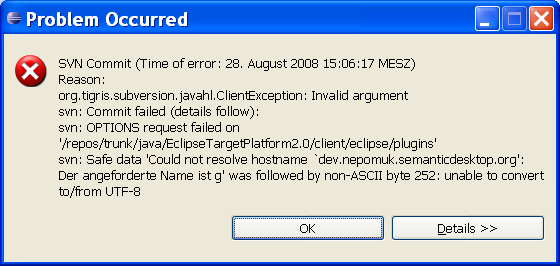
perfect exception

perfect exception

Its the perfect exception:

* Its stacked, many things happened at once
* I saw it only once and clicking OK solved it
* It includes a ASCII to UTF-8 encoding problem which usually means that you will rot in debugging for a long time
* It is related to the internet
* It mixes multiple languages: Deutsch und English
* You have no clue what it means
* It is truncated and it seems some important part is missing

Semantic Desktop Article on Linux.com

Horray: Nepomuk and KDE to introduce the semantic desktop, an Article by Bruce Byfield on August 26, 2008 on Linux.com.

Read the article:
http://www.linux.com/feature/144853

Here is the beginning lines:

If you follow technology trends, you have probably heard of the semantic desktop — a data layer for annotating and sharing the information in your computer. But what you may not be aware of is that the semantic desktop is not a distant goal, but scheduled to arrive at the end of 2008. And, when it does, the idea will probably be implemented through the work done by the Nepomuk project, and, most likely, by KDE first.

Ansgar Bernardi, deputy head of the Knowledge Management Department at Deutsches Forschungszentrum für Künstliche Intelligenz (DFKI, or the German Research Center for Artificial Intelligence) and Nepomuk’s coordinator, explains, “The basic problem that we all face nowadays is how to handle vast amounts of information at a sensible rate.” According to Bernardi, Nepomuk takes a traditional approach by creating a meta-data layer with well-defined elements that services can be built upon to create and manipulate the information.

“The first idea of building the semantic desktop arose from the fact that one of our colleagues could not remember the girlfriends of his friends,” Bernard says, more than half-seriously. “Because they kept changing — you know how it is. The point is, you have a vast amount of information on your desktop, hidden in files, hidden in emails, hidden in the names and structures of your folders. Nepomuk gives a standard way to handle such information.”

I like the part about the forgetting colleague 😉
Well, now I at least remember the name of my wife….
Its good to be able to tell a story that connects to daily life problems, a seldom moment where a Semantic Web app solves a common problem 😉

5.10.08 Digitalcouch läd ein zum The Great Escape ins Cafe23

Unser persönlicher The Great Escape von hier liegt für uns noch in der Zukunft. Bis dahin sind wir WahlLauterer und verbringen unsere Zeit in dieser Metropole der Pfalz. Wir warten nicht ab, das jemand uns Zeitvertreib organisiert, sondern organisieren selber und schauen dabei gern mit Laptop und Beamer über den Tellerrand von Kaiserslauern hinaus.

Offenes Treffen / Eintritt frei.

15.10.08
19:00 – 22:00
The Great Escape ins
Cafe23
Pirmasenser Str. 5 / Eingang Glockenstrasse
http://www.cafe23.de/

Nehmt USB-sticks, videos und shit aus dem Netz mit!

vorige great escapes:

für die couch,
Jens Rinne und Leo Sauermann

Debategraph – arguments exposed

For years we have been debating using xam.de’s “Issue Based Argumentation in a Wiki” IBAW. This technique allowed us to gather arguments for crucial decisions in the NEPOMUK project.

Now behold debategraph.org debategrpah logo.
Our goal is to make the best arguments on all sides of any debate freely available to all and continuously open to challenge and improvement by all … A wiki debate visualization tool.

Users can add pro/con arguments and deepen them with sub-arguments:
abortion_debategraph

compare it with an IBAW example:
issue: our coffee machine is broken
* idea: fix it
 * pro: cheap
 * con: takes too much time, we can’t live so long without coffee
* idea: buy a new one
 * pro: fast
 * con: expensive
  * issue: we need approval form our director
   * idea: we collect money ourselves

Viral Marketing on Death Star Germany

I love the internet – it brought us this.

A crucial marketing meeting of the galactic empire about viral marketing:

Very well synchronized, excellent drama, and a good story. If you wonder why we love this som much: the original GERMAN version of this video has the same excellent story and drama of executive board meetings. And it has (as of today) 2,083,871 views. Compared to the 98 million inhabitants of Austria+Germany+Switzerland, a market reach of 2 percent – which is enormous for viral marketing 🙂

Permanent Breakfast 23.8. 10:00 Pirmasenser Str 18

Wie auch hier verkündet:

Längere, dem Flashmob verwandt: Permanent Breakfast.

Wie vor zwei Jahren gibt es auch dieses Jahr wieder ein Permanentes Breakfast: das immerwährende Frühstück. Immerwährend sind inzwischen zwölfJahre, im Mai 1996 initiierte der Wiener Künstler Friedemann Derschmidt und seine Gruppe das “Permanent Breakfast”.

Die Regeln sind einfach: einer lädt zum Frühstück ein, alle eingeladenen Freunde bekommen ein ordentliches Frühstück im öffentlichen Raum. Am folgenden Tag frühstücken die eingeladenen und laden wiederum Freunde ein, die Kette setzt sich fort.

Frühstück ist am

  • 23.8.2008,
  • von 10:15 bis 12:00 (pünktlich)
  • bei der Pirmasenser Strasse 18 (Fußgängerzone).

Zum gleichen Zeitpunkt steht an eben der adresse ein Oldtimer, und etwas Kunst vom angrenzenden Unicat laden, d.h. es wird bunt und nett.

Permanent Breakfast

Bitte bringt mit:

  • Tisch und Stühle (zur Not auch Decken, GymFitbälle oder ähnliches)
  • Wir können Tische organisieren, meldet euch bei Leo vorher
  • und Verpflegung.

Das entstehende Frühstück soll formal als solches erkennbar sein, dementsprechend sind tageszeitungslesende Kaffegenießer in Lehnstühlen zurücklehnend am Butterzopf knabbernd ausdrücklich erwünscht.
Bei Regenwetter? Als Kontaktmann für die Frage was bei Regen passiert dient Leo. Ruft mich einfach an: +49 176 24548974. leo(at)gnowsis.com

SPARQL and number comparison in Sesame

A colleague of mine wanted to do a simple number comparison in Sesame2, and couldn’t make it out of the box. Because you may also want to query for “?blogposts nao:numericRating ?rating. FILTER (?rating > 8)”:

  • This won’t work: FILTER (?rating > 8)
  • This will: FILTER (?depth <= ‘5’^^<http://www.w3.org/2001/XMLSchema#integer&gt)
  • If you didn’t guess it already: its single hyphens, double hyphens won’t work!

A whole query is:

SELECT ?blogpost ?rating WHERE {
?blogpost nao:numericRating ?rating.
FILTER (?rating >= ‘8’^^<http://www.w3.org/2001/XMLSchema#integer&gt) .
}

Thanks and kudos to Manuel Möller
What is NAO? An ontology used on the Semantic Desktop to rate things. So, if you give stars to something in KDE 4.0, its a NAO triple…

sabbath

Its sunday and I wanted to really do shabatth/sabbath/a day of rest. So I looked it up, its 2Mose20, 8-11.

The rule is: rest. don’t work. look back on what you did and enjoy. It doesn’t say explicitly to give something to god on sunday, more to do it like god.

Interesting bit: the laws go on about the seven-day rule. Sticking to sabbath is a sign of the holiness and separation of Israel. On the seventh day, also animals and workers should rest. Also, every seven years, the fields should rest and be open for poor people to eat whatever grows there, and to the animals of the wild. This is especially interesting: the fields should recover from agriculture every seven years, and wild animals have a right to roam them every seven years. I interpret this in the meaning that different fields take sabbath in rounds, there is always a few fields on sabbath.

This also shows how god thinks about agriculture and sustainability, its built-in since Moses. More on this in the next days, I found another good rule: three festivities are required each year 🙂