about Eclipse and other rich client GUIs for the Semantic Web

In the last year, I was involved in many discussions revolving about the question of “how to make a semantic desktop gui”. Semantic Web guis in general have to be dynamic, adaptive, generic, because the ontologies are changing and data of two ontologies can be mixed. This causes friction in software development, when all our frameworks and developers are used to relational databases or compiled Java beans that hold the information.

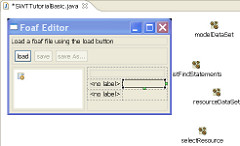
To gather my own thoughts for our NEPOMUK project I have prepared some slides to get an overview, a document summing up my view, and a screencast showing one framework.

If you are interested in Semantic Web guis on the desktop, have a look. If you have a similar itch to scratch and want to join our open source projects, contact me!

Reification (the other meaning)

Reification is the soul of the Semantic Web” is a good example of reification in the Marxist interpretation. Don’t believe me? Then stumble yourself accross the wikipedia article on reification (marxism).

Reification (German: Verdinglichung, literally: “thing-ification”) is the consideration of an abstraction or an object as if it had human (pathetic fallacy) or living (reification fallacy) existence and abilities; at the same time it implies the thingification of social relations.

More:
Ordinary examples of Reification

Reification occurs when specifically human creations are misconceived as “facts of nature, results of cosmic laws, or manifestations of divine will”. [3]

Reification is very visible in advertising when the advertiser or designer deliberately tries to associate a commercial product with all kinds of desirable qualities or contexts, with the suggestion that if you buy the product, that you will have access to or experience those desirable qualities. The product thus acquires an deliberately contrived imaginary status in addition to its real status.

A very graphic visual example of reification is pornography in which sexual acts are separated out from the total human context in which they occur.

Reification also frequently occurs in language and any form of communication which involves the representation of things or relationships by symbols. For example, the sentence “Make your money work for you” contains a reification, because money does not do any work at all, people do. The power to do work is falsely attributed to money.

A characteristic of mental illness can be that the mentally-ill person reifies himself or parts of the world around him, misplacing the true context of things, or attributing powers to himself and to objects in the world which they do not really have.

Because of heavily copy/pasted from wikipedia, this blog post is under available under the terms of the GNU Free Documentation License.

Semantic Web Case Studies Published by SWEO

Do you want to know what problems the Semantic Web solved?

The Semantic Web Education and Outreach (SWEO) Interest Group is pleased to announce the first set of Case Studies and Use Cases giving some examples of how the Semantic Web of machine readable data is used today. Applications are presented in areas ranging from automotive to health care, and from B2B systems to geographical information systems. The SWEO Interest Group will continue to publish new Case Studies and Use Cases in the future; an RSS feed for new submissions is available. A short overview is also available in Open Document Format, PDF, and HTML formats.

see the original post by Susie Stephens at W3C.

Internships / Diploma Thesis / Hiwi Jobs

We are offering several open positions for projects in the Semantic Desktop area.

At the moment, the question is: how to support knowledge workers with the Semantic Desktop? Clever AI algorithms, text analysis, personal ontologies, flickr-mashups, many roads lead to the goal of smart computers.

This topic can be done by you as a diploma thesis (or internship, if you are not at the end of your studies yet):

I also search for assistants for implementing user interfaces and other things at hand.

Requirements are:

  • Java developing
  • Basic Semantic Web knowledge (you shouldve created a few triples)
  • You have your own homepage or show us by other means that you are capable of presenting your work
  • Preferably you are near Kaiserslautern, or live in Germany, plan to move here

We offer a challenging task and a friendly work environment, as you can see, we expect well-thought work and qualitative results from you.

Apply to sauermann[ad]dfki.uni-kl.de.

ANNOUNCEMENT OF Aperture 2007.1-alpha4 RELEASE

http://aperture.sourceforge.net/

Aperture is a Java framework for extracting full-text content and metadata from various information systems (e.g. file systems, web sites, mail boxes) and the file formats (e.g. documents, images) occurring in these systems.

The entire Aperture Framework has been rewritten to utilize the RDF2Go framework.
It is now completely independent from the underlying RDF store. Aperture registries
and factories can now be used in an OSGi environment as services. The
infrastructure allows for on-the-fly deployment of new extraction components.

download the new release:
http://sourceforge.net/project/showfiles.php?group_id=150969

Additional improvements include:

– the logging subsystem has been changed from Java Util Logging to SLF4J. This solves
some classloading issues that were encountered when using Aperture in
web applications.

– a set of OSGI BundleActivators have been added for embedding Aperture
in an OSGi environment. Additional ant target creates two OSGI bundles from
Aperture source code. The OSGi setup has been tested extensively
in the Nepomuk Social Semantic Desktop project.

Updated dependencies
– updated Sesame 2.0 from alpha-3 to beta-4
– updated the applewrapper library to version 0.2
– RDF2Go 4.4.1
– Sesame 2.0-beta4 RDF2Go Adapter revision 2682
– SLF4J 1.3.0
– osgi.core-4.0.jar – The reference OSGI jar file, necessary to compile activators.
– don’t use apache commons-logging anymore, the RDF2Go depends on commons-logging
but this is now done with the jcl104-over-slf4j bridge
– removed the original commons-codec.jar and replaced with an OSGI-friendly
bundle org.apache.commons.codec_1.2.0.jar
– org.apache.httpclient_3.0.0.rc2.jar

best regards
Leo Sauermann
Chris Fluit
Antoni Mylka

Screencast about the GnoGno Framework

When developing rich client applications for the semantic web, components for visualising and editing RDF data are useful.

The gnogno framework is an approach to bind RDF models from RDF2Go to Swing and Eclipse SWT widgets. It allows to edit text values, make lists, and program user interfaces using a clear design pattern. The RDF data can be taken from various frameworks, such as Jena or Sesame (RDF2Go wraps these). Inspiration for this project comes from the Borland DataSet components, part of Delphi.

I made a 20 minute screencast showing some basic components

gnogno screencast

At the moment, gnogno is alpha and subject to change, but I would like to hear feedback from you about the principal idea, and if you want to use this project, you may want to join me developing it. Its free software/open source. Please add comments with feedback here to this blog-post.

Why did I do this? I was a professional Delphi programmer before I did Java and Semantic Web, therefore I dig these simple frameworks that bind data directly to the gui.

Webinale 07 wrapup

This week I attended the webinale 07 conference, which circles around Web technologies. seemespeakat_webinale07

There were a lot of talks, where most of them had the word ajax in their title. Some of the talks where by experts on general topics, such as rapid prototyping, or by experts on very specific topics, such as their own product. I never heard anything uninteresting. It was a great place to socialize and to find possible vendors and customers. Even I, the semantic-web-is-no-business-yet freak, had some interesting lunchbreak meetings. Two students with whom I worked were also there, by chance.

The social event on tuesday evening – dubbed “webinale at night” – was organized perfectly, good food, professional DJ, enough alcohol. Only the rule of “have 50% women at an event” was severly broken, we need more women in information business and science. Very positive on the social event: no boring speech before the buffet was opened, it was all socializing.

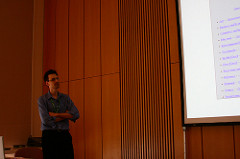
My own talk was about – Semantic Desktop. I included a few slides about RDF and triples and RDFS and how simple and restful everything is up front, a one minute crash-course in Semantic Web. They are not perfect, but good enough to kickstart a few brains out there to think about the future of their data. Nepomuk was trimmed down to one slide this time, and I skipped most of the gnowsis slides while presenting. Maybe someone took pictures of my talk, add comments here if you did…

My slides are for download here:

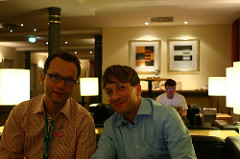
I met Benjamin Nowack at the conference, his talk was about Semantic Web and Web 2.0:
Me and Benjamin Nowack

There were many cool people like Ben Ramsey:Ben Ramsey

and people with suits that know how to make serious money. I was specially impressed by Florian Müller from CTP who seems to have the skills to do projects professionally, quickly, without causing too much stress on everyone, and probably for serious money.
Florian Müller von Cambridge Technology Partners

Christoph Janz from pageflakes.com held an, I would say, “oscar-nominated” powerpoint presentation about their website, with much humor and feature details.

Christoph Janz von pageflakes.com.

Everyone wore crazy t-shirts, and was somehow working in it business. wong the web shirt

Bengee gave his talk about RDF and stunned everybody with the great powers at hand (and with too much technical details, in my opinion)
Bengee showing off RDF

The only real sucker at the conference was the laaaaaaaaaaaaaagging internet connection. A lame setup of about 10 different wireless networks, of which some may work, some not, but surely not for hours, made it a never-ending quest for online time.

being online on a random base sucked a for me only a litte, but much for the Microsoft Keynote speaker who wanted to present the new Microsoft Online Platform. Well, without web, thats a show-stopper. It took the admins a few minutes to get him online, after he was disconnected. Nevertheless, Paramesh Vaidyanathan is a professional keynoter and kept our attention during the lag.

Bad internet connection

So, if someone has a business for doing good wifi at conferences, here is your customer.

For me, the last talk was a “framework smackdown” where some major web frameworks were compared. Rails, JSF, GWT, Pylons, qooxdoo, Ruby-On-Rails, Flex, Zend. Web Framework Smackdown

The message for me was: they are all ok, the free ones are harder to use, and the big players don’t care so much for web standards. Doing a whole website with flash seems perfectly ok for some companies.

Anyway, next year they are going to do the conference again, and if you are in the web business in germany, you may want to go there. Not only to know about the latest and best ROI web frameworks, all the big players in the web industry are there, but also to get connected to people you wouldve not expected.

Software and Support Publishing House also does other conferences in Germany, so you better check out their conference website. They are a major publisher of magazines, like the php magazine, eclipse magazine, .Net, etc etc. you hack it, they have it.

Webinale 07: met OpenLaszlo and Raju Bitter

Attending the webinale 07, the German business conference on web technology. Today, I saw many interesting things, one pitched out, a technology that existed for many years, and now, given semantic web 2.0, gains value.

Its OpenLaszlo, a framework to program user interfaces. I met Raju Bitter, the community manager of Laszlo, a kind of Laszlo evangelist.
openlaszlo logo

OpenLaszlo is an open source platform for creating zero-install web applications with the user interface capabilities of desktop client software.

OpenLaszlo programs are written in XML and JavaScript and transparently compiled to Flash and, with OpenLaszlo 4, DHTML. The OpenLaszlo APIs provide animation, layout, data binding, server communication, and declarative UI. An OpenLaszlo application can be as short as a single source file, or factored into multiple files that define reusable classes and libraries.

OpenLaszlo is “write once, run everywhere.” An OpenLaszlo application developed on one machine will run on all leading Web browsers on all leading desktop operating systems.

The interesting things for us Semantic Web people is:

  • The guis are described in an XML language, similar to XUL or HTML … or similar to Fresnel (aha!)
  • They run the XML guis in an Laszlo Interpreter … like Adenine/Haystack
  • They GUIs are rendered either in DHTML or flash
  • The whole data model is XML … why not RDF/XML

My assumption is that the framework takes, like any framework, some time to learn and train your developers, some investment, etc… but when I look at user interfaces like Jibberjims FoafNaut, I would guess they could also be hackeed in Laszlo, and better extended….

Permanent Breakfast Startfrühstück Nachlese

Sonntag, 20. Mai 2007 war in Kaiserslautern Permanent Breakfast Startfrühstück für diese Saison der dauernden Frühstücker.

Es war uns ein gemütliches Beisammensein beschert, um Sonntägliche gemütliche elf Uhr vormittags. Diesmal nicht so viele Leute wie letztes Jahr, aber das Essen war sehr gut.

Photos hier:
http://www.flickr.com/photos/leobard/sets/72157600241015354/

hier die einzige Perspektive des Stiftsplatzes, die nett aussieht:
Breakfast