Some note on Austrian History

I am from Austria, and have to blog about some particularity in Austrian history, the “Anschluss”.

The reason to blog, and also to do it in English, is a fatal quote by some elderly politician. On the 12th March 1938, 50 years ago, German troops marched into Austria and connected both countries to form the nucleus of the Third Reich. This is widely known and documented as “der Anschluss” (German term for “the connect”). This marks a dark day in Austrian history, reminded in many public rituals in the last week.

As part of a longer speech at a ÖVP meeting (the Christian-Democrat “conservative/republican” party in Austria), Otto Habsburg said: “kein Staat war größeres Opfer als Österreich”. Which translates to “no country was a greater victim than Austria”. This caused outcry in liberal/left parties and media in Austria, and I would guess also international reactions (if anybody noticed).

In the conservative audience, many giggles followed on some parts of the speech – making me speech-less. Here an article with a picture of our smiling ex-chancellor Wolfgang Schüssel and Otto Habsburg. You don’t fucking smile when you hear this bullshit, you leave the room. To his remedy, the article says that Mr Schüssel intervened and corrected the sayings of Habsburg (so much for inviting the right keynote speaker to your anti-nazi commemoration).

From what I know, shortly after the war Austria positioned itself as “first victim of Hitler”, to get rid of the scent of failure attached to losing the 2nd WW. Since then, this question is publicly discussed. The question is: did Hitler occupy Austria and the inhabitants were victims or was he warmly welcome and Austria was well-nazified already. Nobody can surely know, but some facts are historically known. Within a few weeks after the Anschluss, 70.000 people were imprisoned and a systematic, institutional, and coordinated suffering was imposed on Jews, Homosexuals, Left-Wing politicians, Communists, … . This was well prepared before, you need to have collected these names beforehand, it needs organisation and preparation. Within hours after the Anschluss, vandalism on Jewish property happened. It is hard to believe that Germans did this vandalism nor collected the names of “enemies of the state”, it can be assumed that Austrians did this, with the clear goal to steal some of this property their Jewish neighbours had worked hard for.

It marked the beginning of the holocaust and the role of the Austrian population was both victim, as the Jews and Left-Wings were Austrians, and agitators. Many had been forced to collaborate with the regime under the pressure of loss of life, property, and liberty, but surely not everyone had to be forced to collaborate. Austria was not “a little victim” or “the Jews were Austrian victims”, many people were attracted by Hitler or did not circumvent what happened. Objectively, it can never be known, but surely calling “Austria” a victim is far than politically uncorrect.

Personally, I hate it because many creative people, inventors, scientists, artists, queers, and freaks, were either killed or driven out of the country in the following years. And I hate the small-mindedness of some people who defend their ancestor’s sins as being right until today. (End of historical ramble, go on reading slashdot now folks)

DigiTalks im Museumsquartier: Social Networking

Keine Ahnung von Web 2.0? Was bitte ist Xing und warum soll ich “dort drin” sein? Hier kommt die Antwort.

Meral Akin-Hecke organisiert regelmäßige Veranstaltungen zum Thema Web und Net, die digitalks.at. Der nächste ist folgend:

DIGITALKS 05 / SOCIAL NETWORKING TOOLS
Datum: 8. April 2008
Location:Museums Quartier Wien, quartier21, Raum D
Beginn:19 Uhr, Einlass ab 18:30

Anmeldung

Im O-Ton:
Beim nächsten Digitalks gehen wir auf online Technologien ein, die uns neue Alternativen bieten, miteinander in Verbindung zu treten und unsere privaten und beruflichen Beziehungen zu pflegen.

Nach einem Einführungsvortrag von Medienberater Ritchie Pettauer werden zwei erfahrene AnwenderInnen mit uns gemeinsam Profile erstellen und dabei ihre Tipps & Tricks für das online social networking verraten.
Ich freue mich auf ein Wiedersehen!

Meral Akin-Hecke
Digitalks Initiatorin

Ich füge hinzu: wer schon flickrt, delicioust und bloggt wird da wohl nichts neues hören, wer aber mehr über Kommunikation im Netz hören will, und vom freien Eintritt profitieren kann, der soll doch kommen.

Do Animals get Goosebumps because of terrorists?

The masses lost their instincts, and may have more fear from terrorists than cancer.

How much are we animals? Susanna Hertrich has a project on this topic:

This project picks on how much today’s people have detached themselves from their original animal inheritance.

It is said that no other generation before has been as anxious and risk aware as ours. Other than animals, we aren’t equipped for the challenges of contemporary living. We don’t have the abilities to identify the real dangers in a surplus of potential threats and horror scenarios offered to us by mass media.

(photo shamelessly linked from Jonathan)
Jonathan Hartley (whom I met two weeks ago in Krakow) blogged about it from a different perspective:
Susanna Hertrich has an art / thesis project to artificially stimulate people’s threat perceptions (by giving them goosebumps, or making hairs stand on end) in response to actual threats, as opposed to perceived ones. It’s a topic that I’m unnaturally preoccupied with, since the most egregious examples of the disparity between the two seem to intrude on my life every day. My opinions about whether any given threat is real or illusiory seem to differ from almost everyone, but I’m going to stubbornly cling to the idea that everyone else is crazy. Take the entry on ‘terrorist attack’ as an example (see diagram.) Public reactions to the topic remind me of nothing so much as a stirred-up ants nest, a psychotic, ineffectual frenzy.

stagedive from 1st floor

Hey, we were at the “Sportfreunde Stiller” concert on 28.2.2008 in Kaiserslautern, and their frontman dived from about 4-5meter height into the crowd.

What you see here is frontman/singer Peter from Sportfreunde Stiller doing a crazy stagedive from the first floor of the concert hall. Before, he surfed the crowd and climbed up there. ROCK! Sport!

The concert was in Kammgarn in Kaiserslautern, more information in Martin Memmel’s blogpost.

qrobo is the semantic search engine

“QROBO WILL REPLACE OTHERS. The brand-new QROBO is the real semantic web search engine.”

Check this citation yourself at semantics.co.kr to verify this statement. SWESE, Swoogle, look out… 🙂

I met people from the company at CeBit.

Update (9.3.2008): They also patented PERSONAL INFORMATION MANAGEMENT METHOD USING INTERNET in 2007, which shows how completly fucked up the patenting system is when you can patent something like this (which we incidentially publshed as papers 5 years ago and you can download as software since the web exists…)

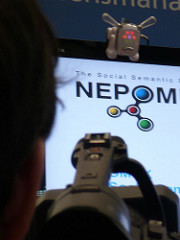
NEPOMUK the single Semantic Web Product on CeBit 2008

We are proud to say: NEPOMUK is the only Semantic Web product on the CeBit fair, the biggest computer fair in the world. Why?

Wanting to search for other people working in the topics of web 3.0 and semantic web, I searched the official CeBit 2008 search engine for products and exhibitors for Semantic Web technologies. The product NEPOMUK came as single result. The only exhibitor mentioning semantic web is groupMe.

First!

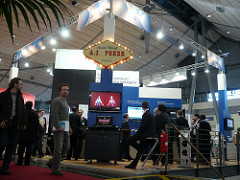
DFKI booth at CeBit 2008

You can see NEPOMUK in Hall9, booth B37, and GroupMe (presented by my good friends from L3S) in the same Hall 9 at booth B22.

headlines: can URIs be ambigous – democracy prevails!

There is a question related to the semantic web, and this question is – will it be a centralized, dictated system or open? Is there “one weird standard to rule us all?”

Update: Roy Fielding, who motivated to write me this post yesterday, answered in a comment and I reconsidered my post, rewriting it (29.2.2008). Updates are Italic, deleted text striked.

The fundamental question as such – is the semantic web a controllable system or a distributed (more chaotic) structure – shows up in different manifestations. I interpret the question of unambigous URIs – one URI for one concept, not multiple – as subtopic of this.

As you could guess already, the answer is no. The Semantic Web is as free, open, uncontrolled, unreliable as the web today, but with more features.

Roy Fielding said (actually cited) that one the Semantic Web’s goal is to unambigously identify resources. He also cited another quote by Tim Berners Lee:
I don’t want the Web to constrain what people do: the Web
is not there to constrain society. It’s there to model society
in its completeness, in its entirety. [Tim Berners-Lee, 1994]

What does this mean? Unambigous means when you talk about the Tesla Car, you must always use the same identifier (in our case, a URI) to refer to it. As could be expected, this idea is not a requirement of the semantic web and not practically required nor used much. Some people state it as a nice scientific goal, but deployers don’t have to care about it as the W3C recommendation has something else to say.

Instead, people continue to say things about the world in blogposts and wikipedia and elsewhere as always, minting new URIs for things as they want. In the Semantic Web, the standard tags “rdfs:seeAlso” and “owl:sameAs” are then used to link the different views about the same thing, or the Tesla. If you want to neen non-ambiguity, perhaps use sindice (or any other semantic web search engine). Horray, freedom of expression and scalability prevails.

And yes, the Semantic Web is already there, for example on openlinkeddata, or on GoPubMed. So maybe Roy’s statement “the semantic web will never happen” indicates Roy is living in the past? We will see in the future…

Sorry Mr Fielding, this sarcasm now rebounds to myself, I was wrong, you are right in citing both positions.

DFKI at CeBit 2008

I will be presenting NEPOMUK at the CeBit 2008 next week,
at Booth B37 Hall 9.

I will be there on 4th and 5th March, if you want an appointment, please phone me beforehand (I won’t read mail that much).
(germany) 0176 24548974

here is the full press release in German:

DFKI auf der CeBIT 2008

Das DFKI ist auf der CeBIT 2008 (04.03. – 09.03.2008) im Rahmen des CeBIT-Konzepts “future-parc” mit einem eigenen Messestand vertreten. Der Stand B37 in Halle 9 umfasst eine Fläche von 72qm und befindet sich in unmittelbarer Nachbarschaft zum Stand des Bundesministeriums für Bildung und Forschung, BMBF (Halle 9, Stand B40). Darüber hinaus präsentiert das DFKI Exponate auf einem weiteren DFKI-Stand, dem DFKI – John-Deere-Stand (Halle 9, Stand C07), auf dem Stand des BMBF und auf dem Gemeinschaftsstand der Universität des Saarlandes (Halle 9, Stand B35).

Exponate auf dem Haupt-Stand des DFKI (B37)

Exponate des FB Bildverstehen und Mustererkennung

  • OCRopus – Open Source Texterkennung
  • InViRe – Intelligentes Video Retrieval

Exponate des FB Intelligente Benutzerschnittstellen und FB Sprachtechnologie

  • BabbleTunes – Sprechen Sie mit Ihrem iPod
  • i2home – Mobiler multimodaler Zugang zum digitalen
    Zuhause für alle
  • Ideas for Games – A.I. Poker im Casino Virtuell

Exponate des FB Wissensmanagement

  • Nepomuk – The Social Semantic Desktop
  • ALOE – A Socially Aware Resource and Metadata Hub
  • iDocument – Intelligent document information extraction
  • Eye-Book – Multimediales Lesen

Exponate des FB Sichere Kognitive Systeme und FB Robotik

  • SAMS – Sicherungskomponente für Autonome Mobile Systeme
  • Robotik Videos

Expoante des FB Institut für Wirtschaftsinformatik im DFKI

  • Pipe – Hybride Wertschöpfung im Maschinen- und
    Anlagebau
  • R4eGov – Organisationsübergreifende Zusammenarbeit von öffentlichen Verwaltungen

Exponate des FB Deduktion und Multiagentensysteme

  • CASCOM – Intelligente Dienstagenten für medizinische Notfalleinsätze
  • MAS-Dispo XT – Multiagententechnologie in
    der Stahlproduktion
  • Scallops – Secure Agent-Based Pervasive Computing

DFKI – John Deere – Stand (C07)

Auf dem DFKI-Stand C07 präsentiert das DFKI in Kooperation mit John Deere das Projekt IVIP im Kontext “Green IT”.

Exponat des FB Wissensmanagement

  • IVIP – Intelligente Vernetzung verteilter Informationsquellen zur
    betriebs- und standortspezifischen Planung der Energiepflanzenerzeugung

Das BMBF stellt auf seinem Stand B40 das Förderprogramm der Bundesregierung “IKT 2020” vor.

DFKI-Exponate:


Zentrum für Mensch-Maschine-Interaktion

  • Smartfactory – die
    intelligente Fabrik der Zukunft

FB Intelligente Benutzerschnittstellen

  • SoKNOS – Service-orientierte Architekturen zur Unterstützung
    von Netzwerken im Rahmen öfentlicher Sicherheit


FB Robotik

  • SentryBot – Ein Autonomes, Kooperatives Mehrrobotersystem für Sicherheit und Objektschutz


KWT-Stand (B35)

Forschungsbereich Deduktion und Multiagentensysteme

  • Verisoft_XT (Tom in der Rieden)
  • ActiveMath (Erika Melis)

Hallenplan der Halle 9

Hallenplan_klein

Einen detaillierten Hallenplan
im PDF-Format können Sie
hier herunterladen.