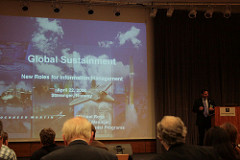
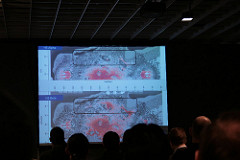
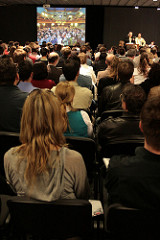
I visited CHI2008 last week, and finally found time to upload the pictures and videos.
The sleeping phone:
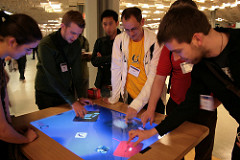
Naturalinteraction.org table:
my pictures from the set:
http://www.flickr.com/photos/leobard/sets/72157604570968864/


personal weblog of Leo Sauermann
I visited CHI2008 last week, and finally found time to upload the pictures and videos.
The sleeping phone:
Naturalinteraction.org table:
my pictures from the set:
http://www.flickr.com/photos/leobard/sets/72157604570968864/


The Semantic Days 2008 Conference will be next week, Stavanger, 21-23 April 2008. From Monday 21 to Wednesday 23 April 2008 at the Clarion Hotel, Stavanger.
In the words of the organizers:
Semantic Days is an annual conference that has become a meeting place for industrial use of Semantic Web technologies with significant contribution also from research institutions and universities.
My talk will be on Semantic Web in use on the first day.
For the interested social researcher:
I let xing.com check if people from my desktop address book are on xing, and if I am connected with them (a feature that linkedin had before them, I think).
Does this say anything scientifically? Hm….
and, you 53 people, expect to get mass-mailed soon…
For the german readers….
Springer hat Kapitel aus einem Buch bei dem ich beigetragen habe online, aber nur für Springer Abonnementen (und eigentlich ein alter Hut, aber vielleicht doch für jemanden interessant)
http://dx.doi.org/10.1007/3-540-29325-6
” Semantic Web – Wege zur vernetzten Wissensgesellschaft”
What participatory Art project do you bring into the desert to Nowhere2008 festival? It has to glow, it has to look amazing, it has to be less than 5kg and 5 liter space to fit in the luggage in the airplane?
You have to bring an idea. The idea is combining Led lights with TapeSculpture.org, a form of street art developed and perfected by Mark Jenkins.
The core of the idea is that the ingredients are cheap and can be bought virtually everywhere:
Read the tutorial or watch the video by Mark Jenkins:
An technique that can be easily tought and copied. Excellent. Mash it up with LED Throwies (I use AA batteries) and we have lighted art.
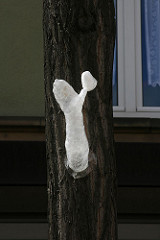
Here is my first real piece, the Rabe:

Its a great piece of DJ art to give light to your labels:

And a second one, appearing magically today in Kaiserslautern:

Why should you provide the data of your website in RDF? To let the users use it! If you got news on your page, you may already have an RSS feed, but if you got calendar items, people, friend networks, tags – triplify them! Then the users can mashup the data they created.
And you can win a MacBook Air 🙂
The
I-Semantics Conference
includes a Linking Open Data Triplification Challenge which will award three prizes to the most promising triplifications of existing Web applications, Websites and data sets. The prizes are:
For the success of the Semantic Web it is from our point of view crucial to overcome the chicken-and-egg problem of missing semantic representations on the Web and the lack of their evaluation by standard search engines. One way to tackle this problem (some might say the only one) is to reveal and expose existing structured (relational) representations, which are already backing most of the existing Web sites. The Triplification challenge aims to expedite this process by raising awareness and showcasing best practices.
Imagine you could avoid an animal experiment if you would find the result of the experiment online?

Press Release/Transinsight:
the knowledge-based semantic search engine www.Go3R.org is now available online. It enables information transparency for the prevention of animal testing.
In only four months development time, Transinsight from Dresden, Germany, succeeded in making available online Go3R, the worldwide first knowledge-based search engine for alternative methods to animal experiments. Via www.Go3R.org, scientists from all over the world can take advantage of the benefits of semantic searches for the area of alternative methods in accordance with the 3Rs principle. The Search engine can from now on used as Beta version.
The so-called 3Rs principle developed by Russell and Burch in 1959 stands for Replacement, Reduction and Refinement. It describes scientific methods that can either replace animal experiments, or reduce animal numbers or refine the suffering of the animals during the procedures. In the European Union, compliance with the 3Rs principle is legally required. In accordance with the EU Laboratory Animal Directive, just as with the German Animal Welfare Act, animal experiments may only be performed if the scientific goal pursued cannot be achieved by any other means, i.e. in totally non-animal procedures, or in methods using fewer animals or entailing less animal suffering.
In practice, however, this legal requirement oftentimes is not met, because the scientists and the responsible authorities are unaware of 3Rs alternatives that would exist to the respective foreseen animal experiment. Queries for alternative methods are time consuming and cumbersome, and this situation has possibly even become worse in the era of the internet. Additionally, at the end of a search, it remains unclear whether all relevant information sought for was indeed retrieved. This is where the search engine Go3R sets in.
News from the PIM 2008 workshop. I made some pictures, Manas Tungare uploaded them here.
look great on black 🙂

Great workshop, nice to meet all the people I have been citing for long.
Thomas Bandholtz blogs about cool-URIs in a RESTful World.
http://www.infoq.com/news/2008/04/cool-uris-rest
He summarized literature about URIs, SOA, and REST into something combined:
RESTful SOA may argue that this mainly fits for a provision of fix document files. A dynamic SOA server can easily implement this “generic” URI concept without any redirection, just by rendering the content in the requested format on demand. This view satisfies content provision, while the redirection architecture better supports linkage and reference. It also leverages resource management and governance, be it in the Semantic Web, or in RESTful SOA. And may be these two application areas are not so distinct from each other.
If you look at one paper from the CHI2008 conference, look at “Video Browsing by Direct Manipulation“. The conference is the place where innovation in computer-human interaction is presented each year.
Video and more documentation available at
http://www.aviz.fr/dimp/
A small video is available here:
http://www.dgp.toronto.edu/~bonzo/index.html
The idea of this system was developed by four groups in parallel, without being aware of each other (in the beginning) … the other paper was “DRAGON: A Direct Manipulation Interface for Frame-Accurate In-Scene Video Navigation”
Abstract:
We present a method for browsing videos by directly dragging their content. This method brings the benefits of direct manipulation to an activity typically mediated by widgets. We show that this method can out-perform the traditional seeker bar in video browsing tasks that focus on visual content rather than time.
– just saw the project homepage
I wish they would put the system demo video on youtube. I have both the paper and the video on the proceedings, but its up to the authors to publish this.