Ina O Morchu from DERI Ireland interviewed Eyal Oren about his Job. This 6:45 minute interview contains something about the Semantic Web, Semantic Desktop and rainy Ireland. He also talks about nepomuk.semanticdesktop.org.
summary of ISWC2006
For people who can read german:
I have written a summary about ISWC2006 for www.semantic-web.at.
you can find the article here.
Web 3.0 – what is it?
In a recent article on Entrepreneurs See a Web Guided by Common Sense by the New York Times, the Semantic Web is entitled as Web 3.0. They say:
But in the future, more powerful systems could act as personal advisers in areas as diverse as financial planning, with an intelligent system mapping out a retirement plan for a couple, for instance, or educational consulting, with the Web helping a high school student identify the right college.
The projects aimed at creating Web 3.0 all take advantage of increasingly powerful computers that can quickly and completely scour the Web.
Interestingly, a “Deutsche TelekomTechnology Radar” Article was written by Wolfgang Wahlster and Andreas Dengel, I contributed there a little. We defined the Web 3.0 as: “Convergence of Web 2.0 and the Semantic Web“. Here is the abstract:
The World Wide Web (WWW) has drastically improved access to digitally stored information. However, content in the WWW has so far only been machine-readable but not machineunderstandable. Since information in the WWW is mostly represented in natural language, the available documents are only fully understandable by human beings. The Semantic Web is based on the content-oriented description of digital documents with standardized vocabularies that provide machine understandable semantics. The result is the transformation from a Web of Links into a Web of Meaning/Semantic Web [ ], (see arrow A in Fig. ). On the other hand, the traditional Web .0 has recently undergone an orthogonal shift into a Web of People/Web 2.0 where the focus is set on folksonomies, collective intelligence, and the wisdom of groups (see arrow B in Fig. ). Only the combined muscle of semantic web technologies and broad user participation will ultimately lead to a Web 3.0, with completely new business opportunities in all segments of the ITC market. Without Web 2.0 technologies and without activating the power of community-based semantic tagging, the emerging semantic web cannot be scaled and broadened to the level that is needed for a complete transformation of the current syntactic web. On the other hand, current Web 2.0 technologies cannot be used for automatic service composition and open domain query answering without adding machine-understandable content descriptions based on semantic web technologies. The ultimate worldwide knowledge infrastructure cannot be fully produced automatically but needs massive user participation based on open semantic platforms and standards. The interesting and urgent question that arises is: what happens when the emerging Semantic Web and Web 2.0 intersect with their full potential? We analyze this question throughout this feature paper and present the converging idea that we call Web 3.0. We use the following definition in this paper: Web 3.0 = Semantic Web + Web 2.0. A good example for developing Web 3.0 is the mobile personal information assistant (see Fig. 2). The user makes queries using natural language, and the assistant answers by extracting and combining information from the entire web, evaluating the information found while applying Semantic Web technologies. Today’s second-generation search engines are based on keywords within the syntactic web, while open domain question answering engines are based on information extraction and the Semantic Web.
The whole article can be downloaded here.
get more hot sex movies using semantic web
A weird theory about one aspect of the web is: “If you can’t sell adult entertainment with it, the technology won’t succeed”
So simple minds like me could measure the successfullness of the Semantic Web by seeing how much XXX is advertised in Semantic RDF Spam.
and see, today I got a first measurement:
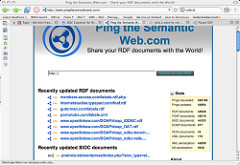
PingTheSemanticWeb recently recrawled pornotube.com/labels.xml
you may not see it anymore, but it was here:
http://www.pingthesemanticweb.com/
This on itself says nothing, and I have not noticed any use of advertisment on the Semantic Web. It is only a small indicator what to expect in the next years. Probably the people in adult (male) entertainment will sniff us up and realize there is plenty of new services to use for advertisement, which is first honoring our efforts and second – spam.
promoting the semantic web
Last week I attended the Fifth International Semantic Web Conference (more reports will follow), and it was interesting indeed.
At the moment we see that Semantic Web is picked up by big business, and that more and more people are putting data on the web. For example, Yahoo Food uses RDF for some detail problems (see Dave Beckett’s post). Bot looking on the semantic web website, I see no guide how to enable my website to be semantic-web conformant. The best practices group published documents how to use it, but they aren’t so easy to find and may not cover everything (for example 303 redirects).
I am annoyed by organizations like rorweb.com , that make advertisment for “RDF-like” solutions, because:
- they have great websites that tell you how to use metadata in 5 minutes
- they look good
- they got statements in the sense of “Our company uses RDF and it changed my life. TCO lowered, ROI is sooner and RDF cleans my teeth while I sleep. Vernor Doe, CEO of example.com”.
- we don’t have such a site
Look at the classical version of foaf-project.org: a limited simple site, saying what it is, how to use it and who uses it. Perfect.
So I explained this view of mine at the web 2.0 panel at the conference and asked “Why can’t the W3C hire one marketing person that creates such a “how to use Semantic Web for dummies” website?”
Reactions were negative, TimBl said that W3C is a standards organization and does not make marketing, Dave Beckett says (and blogs) that he does not want a hype and should instead:
Start from concrete data-centric approaches that build up to use layers of technology solutions to different problems as they emerge, only if needed and demonstrating usefulness at each stage.
Indee, but the use should be shown on a simple example and some success stories – we need a website to collect those. And we need a few guys that transfer the knowledge into understandable bullet points and demos. So TimBl suggested that instead of hiring a marketeer, Leo should just join the Semantic Web Education and Outreach (SWEO) group. Point.
[Update]: Antoni Mylka found a video of this panel discussion, and thus of this discussion.
So, I will evaluate if my current position allows me joining SWEO and if yes, try to contribute somehow to better marketing.
My statement would be: Yes, we need a hype for Semantic Web. Buzzword it out, smush your data, swoogle the web, make the Service Oriented Architecture that takes metadata middleware and enterprise application application integration to the next level.
lookout for our upcoming guide for concept URIs (based on 303 redirect and hash-uris) and more…
google satellite of Burningman
thanks to Martin Wisniowski, who found a blog post on Burningman at google earth, I noticed that Google has put on Burningman pictures on google earth!
I made a screenshot and marked a few things here on flickr, click there for more info:
Explore yourself the Burningman NOW, because in a few months, a new picture will be there, click here:
great escape am 13.November 2006
Hallo Kaiserslauterer,
der nächste Great Escape findet am 13.November 2006 im Glockencafe statt!!! nicht am Montag, dem 6.Nov.
sagt es weiter, bloggt, schreibt was ihr bringen wollt und ruft die Menschen zusammen. Es wird wieder projeziert, Möglichkeiten des Präsentierens usw.
lg
Leo für die Digitalcouch
worlds biggest skateboard ramp, and its got a house in its backyard
a few days ago, I read this very well done article by New York Times on Bob Burnquist who build the worlds biggest skateboard ramp.
Basically, he build a 280.000$ ramp on his land in California. They say he build it in the backyard of his house, but given the dimension of the more-than-a-footballfield large construction, the house is rather in the backyard of the ramp.
If you don’t have a login for NYTimes, click dontbuggme or get an account, this article is worth looking at.
and you must watch the video.
Announcement: Gnowsis Semantic Desktop 0.9.2 released
The DFKI Knowledge Management lab is proud to release Gnowsis version 0.9.2
Gnowsis is a tool for realising a Semantic Desktop – a desktop where all your data is inter-linked and related. Gnowsis gives you a tool for structuring your data as well as your thoughts! This release is part of the Nepomuk project, providing a prototype implementation of some core services.
To see what gnowsis looks like, watch the videos that Dominik Heim made:
GNOWSIS Videos
Gnowsis has a range of features for helping you manage your personal information:
- Integration with Aperture for easy integration of the data in the applications
you already use on your desktop! This release is based on the Aperture Framework
Release 3, for more information about aperture see http://aperture.sourceforge.net
- A new approach to personal information management. We call it your PIMO.
- Integration with the Semantic Wiki Kaukolu, see http://kaukoluwiki.opendfki.de
for information - goodies for developers: AJAX support with XML/RPC
- Quick and easy full-text searching of all your data using Lucene.
Additional new added in this release include:
- Web2.0 Goodies: bookmarklets for tagging pages and creating things, geo tagging of PIMO Locations and showing these on a google-map, showing creation and modification of PIMO things on a Simile Timeline
- Many additional data-sources, both from aperture, and some additional web2.0
sites, such as flickr, bibsonomy and del.icio.us! - Support for PIMO synchronisation over SSH
- Many many bug fixes and minor enhancement
Download gnowsis here:
http://www.gnowsis.org/Download
And for additional information see
- http://www.gnowsis.org
- http://gnowsis.opendfki.de
Contributors to this release include Malte Kiesel, Benjamin Horack, Dominik
Heim, Sebastian Weber, Gunnar Aastrand Grimnes, Leo Sauermann, Antoni Mylka
Aperture 2006.1 alpha 3 RELEASED
We are pleased to announce the third alpha release of the Aperture framework.
Aperture is a Java framework for extracting and querying full-text content and metadata from various information systems (e.g. file systems, web sites, mail boxes) and the file formats (e.g. documents, images) occurring in these systems.
The most notable feature in this release is a new IcalCrawler. It works with
iCal files generated by many calendaring applications (Apple iCal, Korganizer,
Lotus Notes …). It uses a ical-rdf mapping developed by the W3C Rdf
Calendaring group. Apart from that there are numerous small improvements and
bugfixes. The tutorial has been expanded with more code examples and UML
diagrams to facilitate learning for new users.
This the last release before the switch to the RDF2Go framework.
(The curious can already examine the RDF2Go branch in the cvs).
The project homepage:
http://aperture.sourceforge.net
Aperture 2006.1-alpha-3 can be downloaded from here:
http://sourceforge.net/project/showfiles.php?group_id=150969&package_id=166878&release_id=460471
What’s new in alpha-3?
– new IcalCrawler
– added MIME type detection for many formats:
– improved MIME type detection of MHTML files (web archives)
– introduced HtmlParserUtil, containing large parts of the HtmlExtractor
implementation, as HTML (fragments) may occur in other document types
as well (e.g. saved mails, see MimeExtractor)
– added ThreadedExtractorWrapper class, for catching and interrupting
hanging Extractors
– added RepositoryAccessData, an AccessData implementation storing its
information in a Repository
– added ability to specify a port number for an IMAP source
– set target platform to Java 5
Leo Sauermann
Christiaan Fluit
Gunnar Grimnes
Antoni Mylka


