updated my publications page

The lovely task of gathering metadata, like honeybees we wander our files to generate sweet data for the semantic web.

So, I updated my publications page:
publications

That is an interesting task, it works like this:

  1. (install rdf homepage, if you haven’t done yet)
  2. I look at my publications page, what misses
  3. I update my bibtex file, adding all I need
  4. When I don’t know how to do bibtex, I look into Svens or Heikos rdf homepages
  5. I generate bibtex/RDF from it, using some tool we always use for RDFhomepage
  6. I look again atpublications , this time I see what links miss to other people. You see the nice links to all my co-authors? Guess where they come from…
  7. my foaf file. So I have to update my foaf-file, because rdfhomepage compares the bibtex/rdf against my foaf file to find the correct co-author homepages.
  8. But hey, why write your foaf yourself, copy friends-of-friends from foaf-files of friends like Sven and Heiko
  9. I upload the foaf file to niij.org, where Michael hosts my personal website. thx to Michi for that ;-9
  10. I press refresh on my publications page and am delighted.
  11. I go to my “About” page and see that my friends from my foaf file are also there 🙂

this all rocks so hard that Gunnar has written a paper on it, together with some buddies at DFKI, as you can see on Gunnar’s RDF homepage.

So whoops, I forgot to add this paper to my bibtex file…. 🙂

… will do that on monday 🙂

and and by the way, Heimwegehas painted this rocking logo for RDF Homepage, which I cannot hide from you:
rdfhomepage logo

Jean Rohmer and his talk on Ideliance

Yesterday we had two great happenings at DFKI:

  1. Jean Rohmer giving a talk on Ideliance and AI
  2. Gunnar Grimnes celebrating norwegian day

The second will be blogged soon on my private blog, the first is interesting for the Semantic Web out there.

Jean Rohmer, who published a paper last year on Lessons for the future of Semantic Desktops learnt from 10 years of experience with the IDELIANCE Semantic Networks Manager visited us to give a similar talk and discuss about Nepomuk.

Jean Rhomer giving a talk at Kaiserslautern University

More background knowledge about Jean Rhomer: He is a key person in spreading AI in France, as he was responsible for AI at Bull Computers in the 70ies and 80ies, a company that had ~70k employes in its best times, around 200 on AI. He lead the AI department there, google for him.

I will sum up the most witty remarks of his talk:

  • In the 70ies, prolog was the thing and as you didn’t have internet, you really had to look for it.
  • In the 90ies, when investment in AI declined, the AI Winter started
  • I survived the AI winter by continuing AI and making a product out of it
  • 90’s AI apps didn’t look different from procedural apps for end-users.
  • AI was then an expensive way to save money, which only few could afford
  • AI kept fighting and losing against software engineering.
  • The Semantic Web is a compromise between Natural Language Processing and AI.

In the 70ies there was a stop in innovation on the hardware side, IBM machines where all the same for years. So software was the key for innovation. We see a similar situation today: the operating systems do not change much (windows 2000 is the same as XP, Linux evolves steadily) and the hardware is always the same, just getting faster and bigger. So software makes the difference (as we see in the hype of web services).

So Software can make the next innovation.

Then this happend during Jean’s talk and demo of idealance: a bug when clicking a link on ideliance web interface. His reaction was tremendous:

  • alt-tab to server/switch debug on/switch to code editor
  • (all we saw was weird symbols that looked like compiled byte code)
  • scroll down two lines
  • mutter something like “ah, ok”
  • enter two weird greek symbols
  • alt-tab back to demo, it works
  • all this in less then 15 seconds

So what he did was, that during a talk before audience, he had a bug, didn’t get nervous, found the bug, fixed it and didn’t even had to restart. I have never seen something like this before, and the secret behind is:

A Programming Languages
In a session after the talk, we discussed programming languages for the Semantic Desktop, also we wanted to know how he did that bugfixing magic and what these weird symbols were. We were flattened about the statement that Ideliance was completly programmed using APL (A programming language).

We asked him to show us code, and he replied that he will instead teach us how to code APL. behold, this is what Jean Rohmer has written on a Flip-Chart:
DSC00353

The explanation is: that code selects all classes CS of an instance X, for each class C in CS, selects all other instances CI, for all these instances I select all triples, from the triples select all properties.

Then group these properties in a matrix, sort them and only return top X of them.

To do this in SPARQL, you would roughly do:
SELECT p WHERE x rdf:type C. I rdf:type C. I p o.

But then you would need some sorting, merging, splicing.

APL is the weirdest thing I have ever seen, but it has many pieces of code in it that are very useful for handling RDF, though. Jean Rohmer and Gunnar Grimnes are both Prolog fans and they chatted about the relations between ADL and prolog.

*Epilogue*
Using Java to program Semantic Web applications surely is hell when you have to do things like set operations. At the moment I program bits and pieces of the rebirth-machine, for example this code would be much nicer in APL. So we seriously think about combining SPARQL and prolog into some nice semantic web scripting language.

J2SE5 for MacOs

surprise surprise, my MacOs woke up, talked to his friends at Apple and wants to download Java J2SE 5.0 release 4.

Does that implicate that Java 1.5 is now the standard VM on MacOS or is this only because I have installed the JDK 1.5? Whatever the reason is, if Java 1.5 is available, there are no reasons to stick to 1.4 for projects like aperture or Nepomuk.

looking into a better future,
Leobard

and yes, we are far from perfect

ESWC2006, a conference that aims at the semantic web, has a registration system that does not support firefox. In our group we base all our extensions and plugins on firefox and I am using it right now, so I feel “uncomfortable and unwelcome” (cite: movie “your studio and you”). So, the positive view is that they decided not to invest much into the web interface to invest more into the conference. Horray. Here is the quote from the website:

Quote: Firefox is not supported at this time. Recommended browsers are below.
Online Registration System best used with the following browsers:
Internet Explorer (version 4.01 or higher and Netscape 4x-7)

Definition of the Semantic Web:
The Semantic Web provides a common framework that allows data to be shared and reused across application, enterprise, and community boundaries.

  1. Firefox is a boundary of the semantic web
  2. How can a web-application be programmed so badly it only supports one browser? Oh, ASP 🙂
  3. Don’t they see that all this is obviously wrong?
  4. The world is imperfect.

and otherwise, the conference rules.

Permanent Breakfast Startfrühstück 2006 Kaiserslautern

Permanent Breakfast: das immerwährende Frühstück. Immerwährend sind inzwischen zehn Jahre, im Mai 1996 initiierte der Wiener Künstler Friedemann Derschmidt und seine Gruppe das “Permanent Breakfast”.

Die Regeln sind einfach: einer lädt zum Frühstück ein, alle eingeladenen Freunde bekommen ein ordentliches Frühstück im öffentlichen Raum. Am folgenden Tag frühstücken die eingeladenen und laden wiederum Freunde ein, die Kette setzt sich fort.

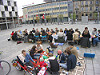
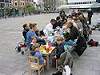
Dass die Kette nicht abgerissen ist, hat heute Kaiserslautern eindrucksvoll gezeigt. Der “great escape”, eine Kunstgruppe/aktion die sich monatlich im Glockencafe trifft, hat die Idee des Permanent Breakfast dankend aufgenommen und verbreitet. Die Ankündigung hat ihre Wirkung durch viel Mundpropaganda weitergefunden, und heute konnten wir mit vierzig Menschen am Stiftsplatz frühstücken. Rechnet man das auf die 100.000 Einwohner Kaiserslautern hoch, ist dieses Frühstück das relativ größte Startfrühstück das je gesehen worden.

Hier die Ankündigung:
Permanent Breakfast am 1.5.2006 in Kaiserslautern

Alle Photos von mir sind bei Flickr in diesem Set. Hier ein paar highlights:
Permanent Breakfast: ein Kultur-Schiff

Blick von oben

Permanent Breakfast

Zusätzlich haben Sven und noch ein Freund vom Florian die Webcam vom Stiftsplatz angezapft und Photos davon runtergeladen. Davon gibts ein nettes Video auf Youtube, siehe da:

Wo ist diese Webcam genau? Siehe da:
webcam auf den Stiftsplatz
besten Dank an Daniel Kabs von Mobotix, der die Webcam kannte.

Die Passanten passierten das Frühstück ohne ernsthafte Interaktion, ein Beispiel für die typische Kaiserslauterer Lustlosigkeit hier zu sehen:

Jetzt, im nachhinein betrachtet, kann ich nur sagen: Weltklasse. Wo wir um 11:00 noch dachten, zu zehnt hier zu sitzen, waren innerhalb einer halben Stunde insgesamt vierzig Leute da und es gab herrliches Essen und gute Stimmung. Um 14:00, als wir dann langsam gingen, waren alle satt und freuten sich auf den all-montaglichen-great escape im Glockencafe, den ich hier auch gleich ankündigen möchte: Nacharbeit heute Abend im Glockencafe, Kaiserslautern.

gnowsis 0.9.0 release

The knowledge management lab at DFKI, Kaiserslautern releases the Gnowsis Beta 0.9.0 today!

Gnowsis is a tool for realising a Semantic Desktop – a desktop where all your data is inter-linked and related. Gnowsis gives you a tool for structuring your data as well as your thoughts! This release is part of the Nepomuk project, providing a prototype implementation of some core services.

Gnowsis 0.9.0 is a brand new release of Gnowsis. It contains a wiki, a simplified ontology editor and plugins to tag files and e-mails in thunderbird. The core idea of Gnowsis remains but most of what goes on underneath the interface has been re-engineered. In the new Gnowsis we have thought longer and harder about our use of ontologies, our use of desktop applications as RDF datasources, and the separation of a user’s data and his mental model of the same. The result is a new cleaner, faster and happier Gnowsis!

Some of the new features of Gnowsis 0.9 include:

  • Integration with Aperture for easy integration of the data in the applications you already use on your desktop!
  • A new approach to personal information management. We call it your PIMO
  • Integration with Kaukolu Wiki.
  • goodies for developers: AJAX support with XML/RPC
  • Quick and easy full-text searching of all your data using Lucene.

Download:

Documentation:

Gnowsis 0.9 runs on Windows, Linux and Macosx.

gnowsis and AJAX: running SERQL queries with XML/RPC

Gnowsis rocks so hard that the neighbours complain. read on to know why:

(also available at this wiki page)

XML-RPC developing with gnowsis

Yes, we have AJAX, and we love it. You can call many services of gnowsis using XML/RPC. The nice thing about this approach is, that every object that is defined as API of gnowsis inside a service.xml file is automatically hosted as XML/RPC server. A small example to show what you can do when calling the TaggingApi:

// Example: call method getPossibleTagsForTagName of API 'tagging' on service 'gnowsis-server'
// (include gnowsis.js and jsolait dependencies)

// call method
var tags = gnowsis_callXmlMethod("gnowsis-server", "tagging", "getPossibleTagsForTagName", rlabel);
// result is an array of maps
for (var i = 0; i < tags .length; i++)
{
  // tag is a map, an array with named index.
  var tag = tags[i];
  // read uri and name of result
  var tagUri = tag["uri"];
  var tagName = tag["name"];
  alert("hey, I found "+tagName+" ("+tagUri+")");
}

What happens in this script?

First the dependencies: to make this run, include the gnowsis.js dependencies. If you run gnowsis, go to http://127.0.0.1:9993/gnowsis-server/PimoTaggingAPI.html for an example.

// (include dependencies)
<head>
<script type='text/javascript' src='web/jsolait/init.js'></script>
<script type='text/javascript' src='web/jsolait/lib/urllib.js'></script>

<script type='text/javascript' src='web/jsolait/lib/xml.js'></script>
<script type='text/javascript' src='web/jsolait/lib/xmlrpc.js'></script>
<script type='text/javascript' src='gnowsis.js'></script>
</head>

When you have done that, the gnowsis_callXmlMethod() function is available. You can test that by calling something simple as this:

// show the uri of the current user.
alert(gnowsis_callXmlMethod('gnowsis-server','configure','getUserUri'));

We called a method to get tags with a certain name in it. The gnowsis_callXmlMethod() method takes three (or more) parameters. The result value is an XML/RPC result. If you want to know what is possible in XML/RPC see at the bottom for the external links. The result value is, in this case, an array containing named arrays (maps).

var tags = gnowsis_callXmlMethod("gnowsis-server", "tagging", "getPossibleTagsForTagName", rlabel);

Note that when the server throws an exception, the exception message will be passed to the xml/rpc client, so you know whats happening when it fails.

The real rocking cool example

Download gnowsis and run this page:

using only these lines of code:

function runSerqlExample()
{
   // turn debug alerts off
   gnowsis_showdebugalert = false;
   var formC = document.forms["formserqlexample"];
   var queryString = formC.elements["rquery"].value;  
   try  {
	   var res = gnowsis_callXmlMethod("gnowsis-server", "dataaccess", "querySelect", 
    	  queryString, "serql");
   } catch (e)
   {
     alert("error querying: "+e);
   }
   renderSerqlExample(res);
}

/**
 * render the serql query result.
 * query result is a vector of hashmaps, pretty easy.
 */
function renderSerqlExample(res)
{
   gnowsis_debug("rendering table");
   var render = "<table>";
   for (var i = 0; i < res.length; i++)
   {
      var row = res[i];
      
      // render header?
      if (i==0)
      {
      	render+="<tr>";
		for (col in row)
		{
          render += "<td>"+col+"</td>";   
        }
        render += "</tr>";
      }
      
      // render row
      render+="<tr>";
      for (col in row)
      {
        render += "<td>"+row[col]+"</td>";  
      }
      render += "</tr>";
   }
   render += "</table>";
   var exampleOut = document.getElementById('SerqlExampleoutput');
   gnowsis_debug(render);
   exampleOut.innerHTML = render;
   gnowsis_debug("finished");
}

yes, you want to dig this?

So what services can I call?

You can call all services that are listed in the corresponding service.xml files.
We encourage you to look at this service first:

  • TaggingApi, you can call the methods defined in the TaggingApi – Javadoc
  • PimoStorage, you can add/remove triples from the pimo via this api.
  • every gnowsis-server API that is listed.
  • note that you can only call methods that have really simple input/output values. Not every method is allowed for XML/RPC access, we are currently working on making more methods available. Only methods with the following datatypes as input/output work:
    • no void result supported (XML/RPC standard)
    • Integer, Boolean, String, Double, javaa.util.Calendar, java.util.Date, byte[], java.util.Map, java.util.List
    • no more. espacially this will not work: com.hp.hpl.jena.rdf.model.Resource !
    • we are working on providing String-based interfaces for most of our methods.

And what about Mozilla and XUL?

Now comes the tricky part: You want to write an XPI plugin for Mozilla Firefox or Mozilla Thunderbird and access the nice sesame repository of gnowsis. That is possible, but it needs an adapted version of the jsolait library and it is easier to copy/paste our working prototype than to hack something from scratch.

So, all Mozilla fanatics that want to SPARQL from out there, please look at the code of this SVN project:

All you have to do is copy/paste the whole project, change some parameters, run the build.xml and you have a plugin for Thunderbird 1.5.

Ok, I want to do AJAX with gnowsis, what to do?

So the first thing you have to do, is run through the usual GnowsisDevelopingBeta. Then, you have a running gnowsis server with all the XML/RPC services available on localhost:9993.

The best way to use gnowsis XML/RPC and AJAX services is, at the moment, to edit the HTML files in /services/gnowsis-server/*.html. They form a nice basis to get started, we frequently enlarge them with more examples. You can also start any other HTML project on your harddisk, Javascript and JSOLAIT are rock-hard technology and run pretty easy.

Restrictions and caveats

No real ajax library used yet. Did you notice? we did not use coldfusion or any other cool Ajax library. We will, surely, soon do that.

Be aware that our server only answers to requests coming from 127.0.0.1. So, you will not be able to run server-to-server programs with it. That is good that way: gnowsis is a desktop server, not a web server. If you feel to change that, you may want to look at that jetty.xml file closer, but be warned: opening gnowsis to the network is not just a small security risk, its really a problem. Don’t open the gnowsis ports to outside, people can easily run shell commands via the XML/RPC port with your user’s rights and cause havoc on your machine.

Links

Apache XML/RPC doc

Dynamic HTML and XML: The XMLHttpRequest Object

flashmob tanzen in Kaiserslautern

link to website

Kaiserslautern: Tanz in den Mai FlashMob in Kaiserslautern
Na, das könnte ein spannendes Experiment werden. Der FlashMob trifft sich Freitag, 28. April 2006 in der Innenstadt, Kreuzung der Fußgängerzonen Fackelstraße/Kerststraße (beim H&M / P&C).

Zeit: exakt 18.30 Uhr

Regeln:

– Es finden sich Paare, die auf dem Platz tanzen. (Ich kann auch nicht tanzen, also halb so wild.)
– Leute, die keinen Partner haben, können mit einer irgendwo gemoppsten Blume auf Damen, oder Herrenjagd gehen. (Blume = Erkennungszeichen)
– optional kann man statt tanzen auch sich umarmen oder küssen
– Der FlashMob endet genau um 18.35 Uhr

– Der FlashMob lößt sich nach der Aktion in alle Richtungen auf
– Weder vor oder nach der Aktion sind Grüppchenbildungen erlaubt (ausser den Paaren)
– Nur Mitmachen ist erlaubt. Erscheinen und zuguggen verboten.

Simple, XSLT friendly RDF/XML

We need a simple RDF/XML serialization for XSLT transformations. I wrote my ideas about this here:

esw.w3.org/topic/SimpleRdfXml

SimpleRdfXml

Using the general RDF/XML spec, the RDF serialization can look quite different depending on rdf-writer implementation. These diversity in writing RDF makes writing XSLT transformation a black art. What happens is that the data shows up in so many different ways, that many people write big hacks to get it work.

Solution: a simple RDF/XML syntax that is RDF/XML compatible but has some restrictions to it. It is kind-of deterministic and can be better parsed in XSLT. I [LeoS] call it SimpleRdfXml.

See Also

Example

This is a fragment of FOAF, using the simpleRDF/XML

 foaf-example:
 <rdf:RDF
    xmlns:foaf="http://xmlns.com/foaf/0.1/"

    xmlns:rdf="http://www.w3.org/1999/02/22-rdf-syntax-ns#"
    xmlns:rdfs="http://www.w3.org/2000/01/rdf-schema#"
    xmlns:owl="http://www.w3.org/2002/07/owl#"
    xmlns:vs="http://www.w3.org/2003/06/sw-vocab-status/ns#"
    xmlns:wot="http://xmlns.com/wot/0.1/"
    xmlns:dc="http://purl.org/dc/elements/1.1/" >
  <rdf:Description rdf:about="http://xmlns.com/foaf/0.1/firstName">
    <rdf:type rdf:resource="http://www.w3.org/1999/02/22-rdf-syntax-ns#Property"/>

    <vs:term_status>testing</vs:term_status>
    <rdfs:label>firstName</rdfs:label>
    <rdfs:comment>The first name of a person.</rdfs:comment>
    <rdf:type rdf:resource="http://www.w3.org/2002/07/owl#DatatypeProperty"/>

    <rdfs:domain rdf:resource="http://xmlns.com/foaf/0.1/Person"/>
    <rdfs:range rdf:resource="http://www.w3.org/2000/01/rdf-schema#Literal"/>
    <rdfs:isDefinedBy rdf:resource="http://xmlns.com/foaf/0.1/"/>
  </rdf:Description>
</rdf:RDF>

Design Rules of SimpleRdfXml

  1. be compatible with RDF/XML

  2. but only a subset

  3. restrict stuff to simplicity

Rules

  1. no nested stuff

  2. all literals as <foaf:name>Hello!</foaf:name> and not attributes like <blub foaf:name="Hello!">

  3. no blank nodes (replace them wirth random uris while serializing)

  4. serious: no blank nodes. They force you to check all the time for different ways to lookup resources.

  5. only full uris, no relative ones

  6. type always as triple, not in xml

Implementations

Using Jena, the easiest way to get it is:

simple rdf:
Model m = ...;
m.write(System.out, "RDF/XML");

bad rdf:
m.write(System.out, "RDF/XML-ABBREV");

more detail

No nested stuff

All literals as elements, not attributes

Querying from XSLT is easy with both, but having to check both all the time sucks. Most hackers go with the element solution, as it can contain datatypes and languages and can have better strings with CDATA elements.

No blank nodes

Thats hard to achieve. The idea behind is to easily query other nodes and follow links, when blank nodes are in game, this is harder.

Full URIS

In foaf-vocab, there is a uri called “../sig” which is the show-stopper. don’t do it

Type always as triple

Wrong: <foaf:Person rdf:about="urn:example"> Right:

<rdf:Description rdf:about="urn:example"> 

  <rdf:type rdf:resource="http://xmlns.com/foaf/0.1/Person"/>

When things have two types, this comes in handy. Again, a step for making it simpler.

Contra-Example

This RDF is BAD RDF and is not simple, it breaks the rules: nono:

<foaf:Person rdfs:label="blub">
  <rdfs:commment>asdafsd</rrr>
  <rdf:hasblub >

     <rdf:descrip....

SimpleRdfXml (zuletzt geändert am 2006-04-24 18:16:00 durch LeoS)