Dieses mal waren wir snow-towing in Kaiserslautern machen. Samstag, 4.3.2006 auf dem Messeparkplatz in Kaiserslautern.
Viel Platz dort und genug Schnee zum Snow-towing.
mehr photos bei flickr
video gibts auch:
personal weblog of Leo Sauermann
Dieses mal waren wir snow-towing in Kaiserslautern machen. Samstag, 4.3.2006 auf dem Messeparkplatz in Kaiserslautern.
Viel Platz dort und genug Schnee zum Snow-towing.
mehr photos bei flickr
video gibts auch:
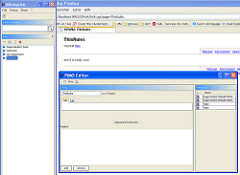
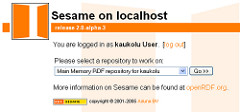
the first screenshot of gnowsis in combination with the semantic wiki.
This screenshot shows how kaukoluwiki and the gnowsis-beta work together.
A wiki-page just created using the JSP-wiki clone kaukoluwiki shows up in the gnowsis swing gui and vice versa.
The trick behind: both graphical user interfaces access the same data, stored using the PIMO-ontology and available in a sesame2 store.
semantic web rocks, semantic desktop rolls!
I re-launched my website using rdf-homepage, our cuper-cool rdf hack of DFKI to generate homepages using RDF and php.
See yourself the beauty of my new website, that is generated from about 10 different rdf files, including:
to make this magic work yourself, checkout our big-hack at
 rdfhomepage.
So here it is official . Mandrive Linux, with Cognium System as Partner has joined the Nepomuk Social Semantic Desktop project.
This project will rock the world, changing the way people interact with computers and socialise.
Basically, this is the thing we have been working on for years and I am happy to also be part of this project.
Read the webpages at http://nepomuk.semanticdesktop.org/ and checkout the people involved with it.
The landscape of open source speech synthesizers is growing richer. The
German Research Centre for Artificial Intelligence (DFKI), partner in
the Network of Excellence HUMAINE on emotion-oriented computing, has
decided to release its emotional text-to-speech synthesis system MARY as
open source.
The system can be downloaded from http://mary.dfki.de
MARY is a multi-lingual (German, English, Tibetan) and multi-platform
(Windows, Linux, MacOs X and Solaris) speech synthesis system. It comes
with an easy-to-use installer — no technical expertise should be
required for installation.
What i liked best is the emotional speaking plugin to play around. Brings up a feeling of c64 speech synthesis but with emotional blendings, great thing to automatically generate the swearword of the day or to motivate yourself by letting mary say how wonderful your work is, repeating for hours.
Just forwarded to my by Frank Osterfeld:
http://www.chipx86.com/blog/?p=154
Announcing Leaftag, our desktop tagging framework. This is an evolution of the original prototype we created, originally named fstaglib (isn’t leaftag just so much better?).
The main part of Leaftag is a library called (oddly enough) libleaftag, which interfaces with the tag database. It’s GObject-based, and the API is quite small. It can tag anything with a URI.
There’s tagutils, a small app used for working with tags and files. It is able to tag and untag files, list all known tags, list all files with a specified tag, and manipulate tag properties (such as icons and descriptions). It also includes some symlinks that provide shortcuts to common tagutils functions (tag, untag, tagls, tags, and tagprop).
leaftag-python contains Python bindings for libleaftag. It simplifies the already simple libleaftag library.
There are two ways of constructing a software design: one way is to make it so simple that there are obviously no deficiencies; the other way is to make it so complicated that there are no obvious deficiencies.”
by way of gunnar grimnes
One of my scientific goals is to be part of cyberspace, to make this possible. Cyberspace means for me, that the world as we know it extends seamlessly into the information world, and things I do here and there are mixed. I go order a pizza by walking (in cyberspace) to the pizza people and doing it, the pizza itself comes here real life.
So let us look at products like Second Life.
Second Life is a 3-D virtual world entirely built and owned by its residents. Since opening to the public in 2003, it has grown explosively and today is inhabited by nearly 100,000 people from around the globe.
I see that the technics are nice, but its not immersive. At the end, Ultima Online may be more immersive than Second Life (compared to interaction possibilities).
Key here is the business department: What kind of business we see in Second Life. There is no real life business there – Where is the sneakers shop in second life that has real life sneakers on the store window? You have this kind of shop in the cyberspace described in the book Otherland, and thats useful.
So – we learn that the 3d technologies are here and the community and customers do exist, but the cyberspace product misses.
And now passively play!
Idle-RPG!
go here:
http://idlerpg.numist.net/oldlebot/
The idea of Idle-RPG is to idle. Idle means, doing nothing. Winner is, who can do nothing longer than the others. In between, while you idle, the game itself plays for you. Every few minutes, you may stumble into an opponent, fight, steal something, find items, etc. But you cannot control this, the game does it for you. So, the perfect use of waste of time. Horray for computers, finally a game I want to play for years.
Shunn those fancy 3d games, come to the chat room and idle. Lets do nothing for years, see how our characters evolve and the world spinning around us. My char-name: Bush And His Pony, evil Alignment.