Asimo History

Honda has published a history of their Asimo robot series, very interesting and a nice background on research: boys, it takes time to make something good.

read ASIMO here!

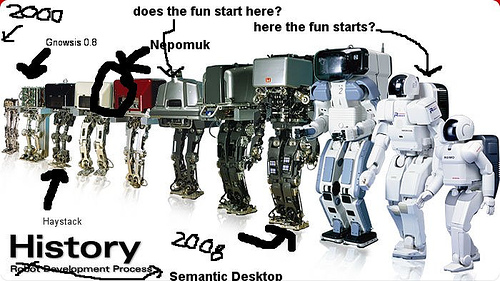
that inspired me te brushup the image by them and compare it to current semantic desktop proceedings. If we compare the state of ASIMO with semantic desktop, it would look like this:
mashup of asimo and semantic desktop

robotics is sometimes as ambitious as semantic web. It hink the current Semantic Desktops look like early ASIMO prototypes while end-users expect them to look like Microsoft Software, like people expect robots to look like Enterprise’s ‘Data’ and robots look like metal with motors.
there is hope though, that we will be faster with semantic desktop than with humanoid robots

Slides of Jean Rohmer’s talk

On 17th May, Jean Rohmer gave a talk on Artificial Intelligence and his Semantic Desktop implementation, Ideliance, at DFKI.

See the previous blog entry. Now we have the slides of his talk to be published. Note that the Ideliance slides are similar to the slides he presented at the ISWC2005 workshop on the Semantic Desktop.

The second slides show a nice screenshot of Ideliance (page three), how Jerome Euzenat and Ireland are connected. You will find many known names there.

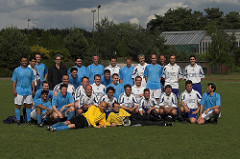
Gunnar Grimnes celebrates Norwegian National Day

Gunnar celebrates Norwegian constitution day, which is 17th of May!

Note the flag and the stripe on his chest. cool.

Wikipedia explains this behaviour by the following historical incident:

After Denmark-Norway was attacked by England, it entered into an alliance with Napoleon, and in 1814 found itself on the losing side in the Napoleonic Wars and in dire economic conditions. The Dano-Norwegian Oldenburg king was forced to cede Norway to the king of Sweden. Norway took this opportunity to declare her independence, adopted a constitution based on American and French models and elected the Danish crown prince Christian Fredrik as king on May 17, 1814.

updated my publications page

The lovely task of gathering metadata, like honeybees we wander our files to generate sweet data for the semantic web.

So, I updated my publications page:
publications

That is an interesting task, it works like this:

  1. (install rdf homepage, if you haven’t done yet)
  2. I look at my publications page, what misses
  3. I update my bibtex file, adding all I need
  4. When I don’t know how to do bibtex, I look into Svens or Heikos rdf homepages
  5. I generate bibtex/RDF from it, using some tool we always use for RDFhomepage
  6. I look again atpublications , this time I see what links miss to other people. You see the nice links to all my co-authors? Guess where they come from…
  7. my foaf file. So I have to update my foaf-file, because rdfhomepage compares the bibtex/rdf against my foaf file to find the correct co-author homepages.
  8. But hey, why write your foaf yourself, copy friends-of-friends from foaf-files of friends like Sven and Heiko
  9. I upload the foaf file to niij.org, where Michael hosts my personal website. thx to Michi for that ;-9
  10. I press refresh on my publications page and am delighted.
  11. I go to my “About” page and see that my friends from my foaf file are also there 🙂

this all rocks so hard that Gunnar has written a paper on it, together with some buddies at DFKI, as you can see on Gunnar’s RDF homepage.

So whoops, I forgot to add this paper to my bibtex file…. 🙂

… will do that on monday 🙂

and and by the way, Heimwegehas painted this rocking logo for RDF Homepage, which I cannot hide from you:
rdfhomepage logo