who would have thought? Zombie outbreak in vienna turns into techno Krocha desaster. Bam oida, loss as krochn, Fresszeit!
article in OilIT Journal on Stavanger Semantic Web Days
In its May issue (volume 13, number 5), the oilit.com Journal published a 1122 word article on the Stavanger Semantic Web Days. It describes the various presentations, including my fine talk on SWEO’s eccentric collection of cases where the Semantic Web is used successfully 😉 It seems that my talk reached a good audience and caused a good resonance in the Oil industry.
The Journal is an IT-related newsletter for the Oil Industry, if you are not in Oil, then it may not be so interesting for you, if you are, read the copy.
Österreich-Deutschland Fussball EM!
Es bleibt noch eine Stunde bis zum Spiel Österreich-Deutschland heute um 20:45. Solange das Leder noch ruht, behaupte ich: das wird der Tag an dem Österreich die Deutsche Mannschaft aus der EM kickt.
Falls dies doch nicht eintrifft, gilt die kabarett-interpretation von Grissemann und Steermann 🙂
Wir werden das erste zuhause gucken und Bier schlürfen, und den Dingen harren die da kommen.
DBPedia Mobile
Show your teeth, Semantic Web. Rrrrrrrr. Ever wanted to have all knowledge there is on your mobile? DBPedia Mobile is it.

Chris Bizer did again the trick he did many times before: initiating a project that can be summed up on one page, can be understood in one minute, and is immediately usable and good for a large audience. In this baby, Christian Becker is his teammate. DBpediaMobile takes DBPedia articles and mashes them up with maps. Multilingual (who would have guesses, with DBPedia’s power finally a use), location-based, IP-based, you name it.
A rocking guy, easy to use. Score!

images embedded from beckr.org for better transporting the idea
Photos from ESWC & SFSW 2008 Online
Finally back in Germany, I uploaded the pictures from Tenerife, ESWC 2008. This also has some pictures from the SFSW Semantic Web Scripting Workshop.
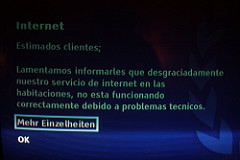
First impression from ESWC was: good increase in quality and community. Second impression: no internet connection.
We showed Nepomuk, anticipating whatever questions come:
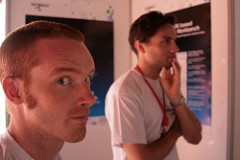
And it was good – Heiko won the best Poster.
Lots of meetings:
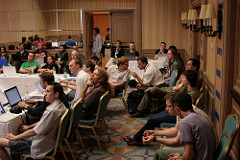
Questions and discussions:
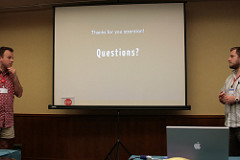
Some scientist who gave their first presentation in front of big audiences:
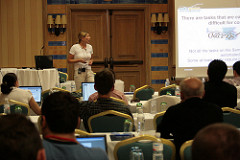
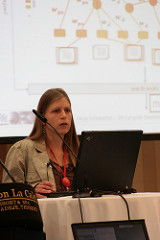
Finally, we had fish:
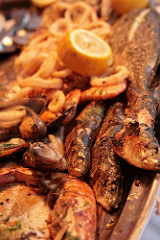
Eswc 2008 first impression
ESWC 2008 is over, and it was interesting. Best paper on combining data mining and sparql. Best poster was Heiko Hallers quikey (nepomuk) and best demo Knud Möller/Laura Dragan/Sebastian Trügs semantic desktop pipes for kde, also from the Nepomuk project. Score.
I kept chatting with interesting people about the future of the semantic desktop and my plans for bringing it to more people. During the whole event internet was rare and I currently type this on my nokia e70 at ristorant pomodoro in san telmo, they have free wifi….. Once I got web, you will see the nice pictures I did on flickr, but don’t hold your breath, from today on I am one week on holiday.
eswc rocks, and although our science is young, it can (in the words of Manfred Hauswirth) “feed itself”., and like an evolving being, starts to walk.
Mashup NMC symposium
In April 2008 there was a symposium on mashups:
http://www.nmc.org/conference/2008-spring-symposium
In their call for proposals they used a picture to illustrate the ideas of mashups:
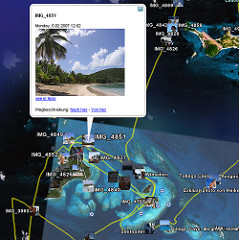
which shows a mashup I coded myself on my home linux box to combine CanonEOS400 pictures with a GPSLogger of a yacht with google earth.
The classical kissology effect: the bits we spent most time on are not as much viewed as the simple nice hacks.
“Singin in the rain” – Dancing naked in Vilnius Center
Watch the dancing Austrian National Rugby Team naked in Vilnius, all over the web:
We (=meaning the national identity of Austrians) lost very high against the Lithuanian team that day.
Sign up for the NEPOMUK Summer School
Join the 1st NEPOMUK Social Semantic Desktop Summer School at Hotel Victoria, Sliema, Malta 7-13 September 2008. For PhD students, learning about Semantic Desktop and PIM, Social Semantic Desktop.
- Application Closes: 9th June 2008
- Notification of acceptance: 16th June 2008
- Deadline for registration: 15th July 2008
The NEPOMUK Social Semantic Desktop EU Project brings together researchers, industrial software developers, and representative industrial users, to develop a comprehensive solution for extending the personal desktop into a collaboration environment which supports both the personal information management and the sharing and exchange across social and organizational relations.
The NEPOMUK Summer School will represent a very good opportunity for postgraduates students to refine their knowledge in a variety of topics such as Semantic Web, Personal Information Management, P2P, HCI or Social Networking, all in the context of the Social Semantic Destkop. It will consist of a range of theoretical and practical sessions taught by leading researchers in the field and combined with a series of mini-projects to encourage collaboration between participants. In addition to the taught and practical sessions, the students will also benefit from and enjoy a stimulating environment through social interactions with the lecturers, tutors or the other students.
Target audience
We welcome applicants independently of the location in the world. As requirements, the applicants should be PhD students, postdocs or young researchers acting in relevant disciplines for the field.
The accepted participants are expected to arrive in Malta on September the 7th and be willing to commit theirselves to the Summer School’s activities, in terms of a full participation, until noon September 13th. Applications that do not fulfill these requirements, will not be considered.
Samsung is gay – not
As Gizmodo put it: Apple Perceived As Gay-Friendly, Samsung Not.
In a study Gay people were asked about their preferences for companies.
So – this makes my Samsung X25 laptop a problem, luckily I tacked an apple on the logo long ago..