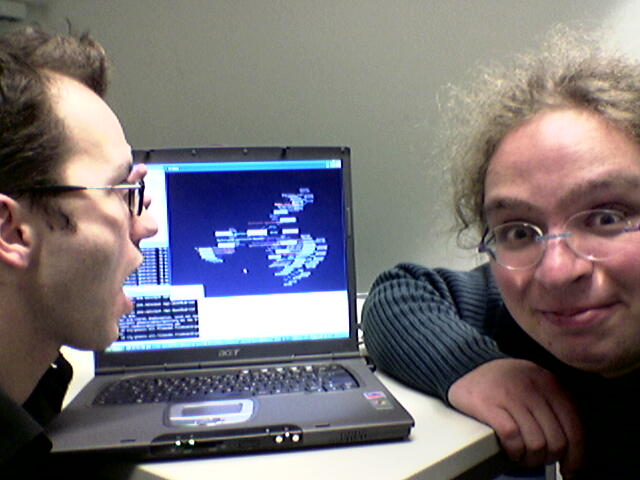
SilverFire first try..

quite a fail.

The Silver Fire project (created by me) is to use ideas from a science fiction novel to create a global party.

the prototype project to this was Gargoyle –

The first step to this vision is to use videoconferencing software to attend parties as a virtual person.

The virtual guest sits somewhere home or in a remote clubbing area (like www.kaiserslautern.de) and wants to attend a party at another physical location now called SilverFireParty.

On the SilverFireParty, another person has a laptop running with WLAN, a Webcam, Microfone and a Video-conference software. The person at the silverFireParty is called PhysicalGuest.

The physical guest plays host to the virtual guest. The physical guest carries his/her laptop to locations of the party, hence the virtual guest is moved there. the virtual guest can attend the SilverFireParty throgh this laptop, the laptop is an Avatar in real world for the virtual guest. The avatar laptop belongs to the physical guest, but is “owned” by the virtual guest as a mean to attend the party.

So the virtual guest sits, bound to his/her avatar laptop, at the party and can drink beer, smoke cigarrettes and talk to people on the party. A global party is possible!

First try:
http://www.monochrom.at/roboexotica/

the outcome of the first try for this project was quite a fail. The chosen webcam by creative did not work on MAc OSX. The WLAN connection at the party was crap and we had netsplits.

The major problem was that the physical guest did not setup the videoconferencing software properly and we needed 90 minutes of ICQ’ing and messing around with drivers when we should be partying. Hence the physical guest should be experienced in Video Conferencing and be also willing to “play host” to the virtual guest. If the physical guest is not dedicated to this, the virtual guest is helpless and alone.

So we can recommend that physical guest and virtual guest have made several video-conferences before and that they both:

  • have a laptop
  • with good battery
  • with WLAN / Wifi 801.11g – fast
  • both have webcams
  • Physical guest needs microphone
  • physical guest needs good loudspeakers
  • virtual guest needs headset
  • both need a good WIFI spot available, if the wifi connection is to a bad or restricted hotspot, it will failf (firewall, ports, netsplit, etc)
  • most important: both need to be dedicated to the SilverFire!

but I was attending as a virtual guest, so it was quite cool.
Functional Theology

how about coding the rules of christian theology as RDF inference engine?

I imagine some funcitonal programming like

class Leo {

run() {
try{
doLive()
} catch (ShitHappens shit) {
God.pray();
}
}

/**
* if i die, i join god until eternity, god never finishes running
*/
die() {
God.join();
}

}

more to come-

the goal is to have an engine, that can interpret the bible and inferences the locigal outcome of events,
f.e.
if (KingDavid.stealsWife(bethseba)
shitHappens()

Fenfire VS Gnowsis

In the fabolous effort to build something called semantic web (or often known as “the topic with the uri http://www.w3.org/2001/sw”), we have gone a step ahead.

Benja Fallenstein from the fenfire project is a visiting scientist at the DFKI at the moment. He came on tuesday and will go back home tomorrow.

The goal of his visit is to discuss ontologies, discuss mutual working together and bringing gnowsis and fenfire closer to each other.

For short:

fenfire kissology:kissed gnowsis

fenfire_hack

The Idea

Fenfire is a research project developing an RDF-based desktop environment, including a great RDF browsing and editing tool. see screenshots. At the moment fenfire uses RDF files (f.e. in Turtle) to get the triples.

Wouldn’t it be great if fenfire would display gnowsis RDF from the Semantic Desktop instead? And if we could press a button and – from the fenfire graph browser – open the displayed resources in their corresponding hosting applications?

The Hack

Benja and me sat together today (18 Nov 2004) and joined our Notebooks in a little Lan. Benja hacked the fenfire part, I added a little forwarding mechanism to gnowsis, bugs in both projects were found and fixed.

10:00 – booting
12:00 – fenfire read gnowsis data and visualised it
13:30 – Benja and Leo run to the Mensa to get something to eat
14:00 – fenfire can open gnowsis resources
15:00 – email hacking begins, we switch to emails as raw data
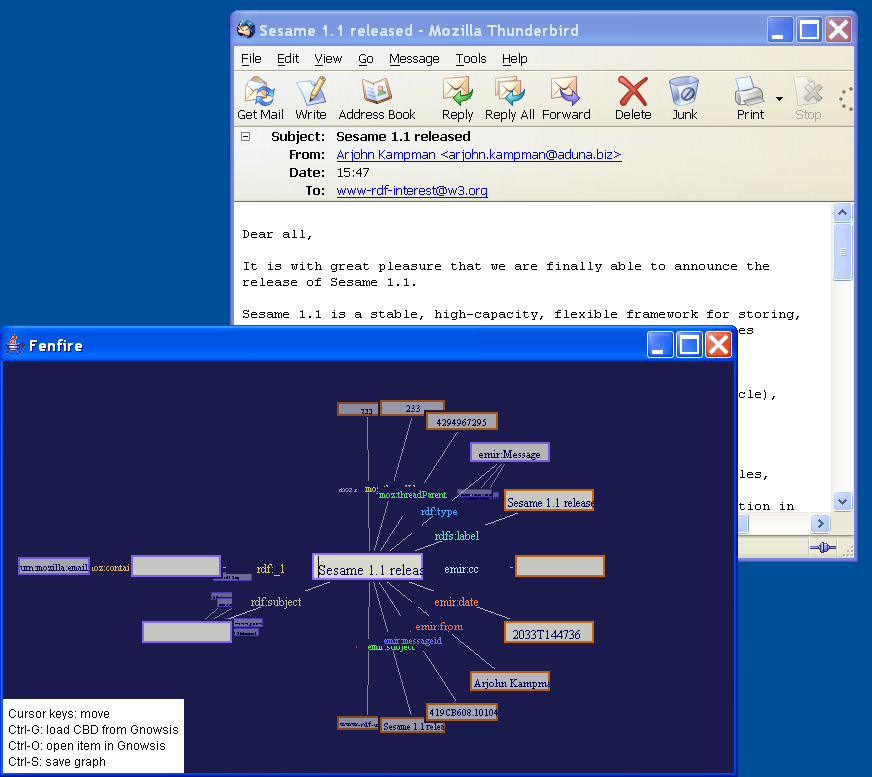
16:00 – fenfire browses emails as graph!
16:30 – fenfire can open emails in Thunderbird through gnowsis
emailopeninfenfire
18:00 – bugfixing, brainstorming, ideas….
19:00 – final fixes with linux & kde issues
20:00 – tireness comes up and we forgot to buy milk for tomorrows breakfast

20:30 – it is done, the proof of concept made

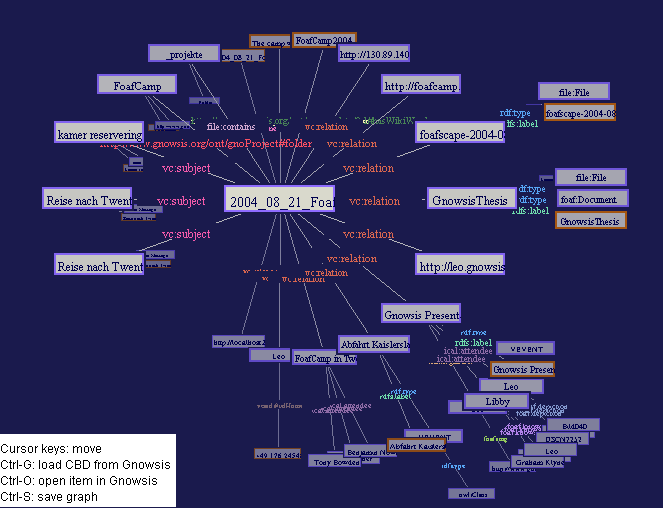
see foafcamp in fentwine!

Gnowsis and Fenfire have met and another time, great Semantic Web developers (aka us) have proven that using ontologies, RDF and web protocols RULEZ. In just a day, two open source projects made substantial integration work.

HOOORRRRAAAAYYYYYYY !!!

Stiegenhaus = 404 the requested word not found

Sprachphänomen:

In Deutschland verwendet man das Wort “Stiege” kaum. Das an sich ist interessant, hat aber auch ein paar praktische Auswirkungen.

Sprache

  • das Wort Stiegenhaus wird nicht verwendet
  • das Wort Stiege wird nicht verwendet

Architektur

  • Die Eingänge von Gebäuden werden nie mit “Stiege 1”, “Stiege 2” etc bezeichnet
  • Eine derartige Bezeichnung ist nicht üblich, man würde auch nicht “Treppe 1” sagen

Dies wurde an mehreren Kollegen und Hilfswissenschaftern meiner Firma getestet. Auch ein Gast, der gerade hier ist verwendet das Wort Stiege nicht.

Die Stiege als Architektonischer Raum hat kein “Stiegenhaus”. Der Weg ist nicht das Ziel. Ja aber wohin geht “der Deutsche” dann?

FEG Kaiserslautern

Nach langer Gemeindsuche hat sich jetzt eine Gemeinde herauskristallisiert, zu der wir öfter gehen wollen.
Wir waren jetzt schon ein paar in der Freien Evangelische Gemeinde Kaiserslautern

http://kaiserslautern.feg.de/

Godi ist sonntag 11:00, was eine definitiv christliche zeit ist. Es gibt Hauskreise und alles was das Herz begehrt, gott ist gut.

Semantic Grid

http://www.semanticgrid.org/

“The Semantic Grid is an extension of the current Grid in which information and services are given well-defined meaning, better enabling computers and people to work in cooperation.”

to the witty Semantic Web insider, this sounds familiar to http://www.w3.org/2001/sw/ says Uldis Bojars.

this inspired me to comment in his blog:

The Semantic President is an extension of the current president in which speech is given well-defined meaning, better enabling presidents and people to work in cooperation.

The Semantic Junk is an extension of the current Junk in which advertisment is given well-defined meaning, better enabling Junk and people to work in cooperation.