Very nice GUI demo of a relational browser, looks similar to touchgraph but moves very groovy. Danish Nadeem pointed me to it.
http://der-mo.net/relationBrowser/

personal weblog of Leo Sauermann
Very nice GUI demo of a relational browser, looks similar to touchgraph but moves very groovy. Danish Nadeem pointed me to it.
http://der-mo.net/relationBrowser/
The day I have infinite time, I can fix all the bugs in gnowsis. I can enter all my wisdom into my semantic desktop and I can exchange my knowledge with others. When I am dead, I am in heaven, because I trust in Jesus. So, when I am dead I have infinite time.
So, the burning question is: will there be computers in heaven? Important theological question, for sure, because worshipping god all day is important, but a relaxing round of starcraft or Quake2 in between would surely please. Ok, perhaps they have much cooler stuff in heaven, but at least coding would be good.
Lets read the relevant literature. The article “will there be harleys in heaven?” by John G. Stackhouse, and recommended to me by Michael Robb has this theory:
When I was 26, my wife and brother prevailed upon me to give up my black Honda motorbike. They were afraid of motorcycles and couldn’t have peace knowing I was traversing Chicago’s expressways and city streets on one. So I gave it up. And I did so with heaven in mind. I theologized that in the life to come, God would give me a whole stable of motorcycles, racing cars, powerboats, airplanes, and other mechanical pleasures I had forgone in this life because of their danger as well as their cost. And if there weren’t motorcycles in heaven, I reasoned, God would provide something better: perhaps airborne “speeders” as in the Star Wars movies.
Star wars speeders. If we have pods and speeders in heaven, we surely have eclipse and Gimp, perhaps infinite bandwith and processing power. So, all those fancy mashups will be free in heaven. cool.
Two things follow for me:
a) the outcome of gnowsis is not so important anyway, when I am dead it is just dust in the wind, soon forgotten
b) I probably won’t need compilers in heaven, when they have 74-Z speederbikes there.
so, if you desperately need a semantic desktop soon, code it yourself. Its all open source. After visiting burning man and knowing that I have 74-Z’s in heaven, there is no pressure to do this myself
😉
Der nächste Great Escape findet nicht am 2.10.2006 statt, sondern eine Woche später am
Montag dem 9.10.2006, ab 20:00 im Glockencafe
Themen sind wie immer: digitale Kultur in Kaiserslautern. Wir haben immer noch Bock, diese Stadt zu rocken. Wenn ihr selber einen Vortrag machen wollt oder eine Idee für ein Projekt habt, was zu uns passen könnte, bitte einfach mitbringen.
liebe grüsse,
eure Digitalcouch
Wir kündigen wieder ein Permanent Breakfast an, ein Frühstück im öffentlichen Raum. Jeder kann ja prinzipiell für sich selbst jederzeit öffentlich frühstücken, aber gemeinsam und angekündigt ists doch schöner.
“Permanent Breakfast” wurde im Mai 1996 vom Wiener Künstler Friedemann Derschmidt und seiner Gruppe initiiert.
Die Regeln sind einfach: einer lädt zum Frühstück ein, alle eingeladenen Freunde bekommen ein ordentliches Frühstück im öffentlichen Raum. Am folgenden Tag frühstücken die eingeladenen und laden wiederum Freunde ein, die Kette setzt sich fort.
Ort und Zeit:
Vor dem Kunstladen “Unicat”
Pirmasenser Str 18
67655 Kaiserslautern
am Samstag, 7.10.2006 ab 10:00
ihr solltet spätestens um 11:00 das erste Ei geöffnet haben, das Frühstück hat ein natürliches Ende wenn wir satt sind.
Der Platz wird uns viel Aufmerksamkeit bringen, die vielen Passanten am Samstag vormittag versprechen einen guten Abend.
Bei Regenwetter! Wird diese Veranstaltung auf unbestimmte Zeit verschoben. Wir werden wohl im Wetterbericht gucken, ob es klappt, wenn nicht, bloggen wir. Für nervöse, einfach bei Leo anrufen oder SMS schicken: 0176/24548974
Mitzubringen ist alles was ihr braucht, üblicherweise ist das:
* ein Tisch
* Stühle
* Tischtuch
* Essen
Das Essen ist meist das kleinste Problem, da wir gerne teilen, Tische und Stühle muss jeder für sich mitnehmen.
Bitte diese Nachricht weiterleiten, bloggen, copy/pasten, ausdrucken, acchiffieren, sprechen, per SMS an alle im Addressbuch schicken, per e-mail weitersenden, lesen. Kommet zahlreich, wenn möglich manisch.
Gunnar Grimnes pointed me to this article by Roger
C. Schank
Note the best part here on Five issues to think about before you try to do real AI, which is related to my other rants about researchers who should dig into engineering:
1. Real problems are needed for prototyping. We cannot keep working in toy domains. Real problems identify real users with real needs. This changes what the interactions with the program will be considerably and must be part of the original design.
2. Real knowledge that real domain experts have must be found and stored. This does not mean interviewing them and asking for the rules that they use and ignoring everything else that fails to fit. Real experts have real experiences, contradictory viewpoints, exceptions, confusions, and the ability to have an intuitive feel for a problem. Getting at these issues is critical. It is possible to build interesting systems that do not know what they know. Expertise can be captured in video, stored and indexed in a sound way, and retrieved without having to fully represent the content of that expertise (e.g., the ASK TOM system (Schank, Ferguson, Birnbaum, Barger, Greising, 1991). Such a system would be full of AI ideas, interesting to interact with, and not wholly intelligent but a far sight better than systems that did not have such knowledge available.
3. Software engineering is harder than you think. I can’t emphasize strongly enough how true this is. AI had better deal with the problem.
4. Everyone wants to do research. One serious problem in AI these days is that we keep producing researchers instead of builders. Every new Ph.D. receipient, it seems, wants to continue to work on some obscure small problem whose solution will benefit some mythical program that no one will ever write. We are in danger of creating a generation of computationally sophisticated philosophers. They will have all the usefulness and employability of philosophers as well.
5. All that matters is tool building. This may seem like an odd statement considering my comments about the expert system shell game. However, ultimately we will not be able to build each new AI system from scratch. When we start to build useful systems the second one should be easier to build than the first, and we should be able to train non-AI experts to build them. This doesn’t mean that these tools will allow everyone to do AI on their personal computers. It does mean that certain standard architectures should evolve for capturing and finding knowledge. From that point of view the shell game people were right, they just put the wrong stuff in the shell. The shell should have had expert knowledge about various domains in it, available to make the next system in that domain that much easier to build.
“Why am i not on google?” – Asked my Friend and prayer partner Michael Robb. He is missionary in Kaiserslautern and I was drinking beer with him yesterday – actually Gromgull also had one of his beers.
So, the answer is probably: because the website of vision of god in europe is not search engine optimized. So blogging about this site probably helps a little, we will see.
Funny, Michael’s website is made very well, nice colors and many options. For example they have a photo gallery. Browsing a little I find a photo of my bible group, which is hosted in my living room. And – oho – photo of fraunhofers. Well, his wife works there. Something like a blog is also there, but no RSS feeds nor comments, so not a real blog.
He started a page about Katharina, but not much there.
So the answer about “why am I not in findeable” is probably – because nobody blogged about you before. hope this helps, and god bless your stuff Michael.
Aduna, the company that is known for guided exploration of compnay information, and of course for programming the sesame server at openrdf.org, and for autofocus, and and and …. they have swichted their business model to open source.
read their statement on open-source.
They have also changed their name to “Aduna-Software”, giving focus on what they do (software).
This continues what I have experienced working with them together on Aperture, the framework I have been using now in the latest gnowsis system to crawl data from various file-formats and data sources. We developed this together, they use it for the new version of Autofocus.
Aperture raised interest, Henry Story from SUN blogged about how important it is to have projects like Aperture to make the semantic web run.
A new website was created to separate open-source services from company issues, this seems to be their open-source portal: aduna-software.org
and look, they use their own tech to crawl their own website and have a search interface.
So, best wishes for Aduna-Software from my side and looking forward for the release of Sesame2.
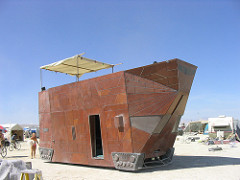
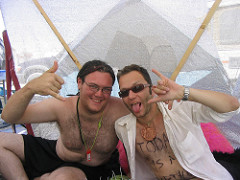
I put the photos of burningman online, here they are in a nice set:
http://www.flickr.com/photos/leobard/sets/72157594286473194/
some teasers:


iddqd
idkfa
idspispopd
idclev
I can remeber these words, since roughly 12 years. What they are, find it out yourself. But I can’t remember Aspect oriented Programming or the names of my colleagues.
dammn it, we need a whole new way of e-learning.
Something we would have needed for the iTrip Disco!
http://www.broadcastyourpodcast.com/

BYP enables and encourages podcasters to break out of the net and into local radio space.
BYP offers podcasters the chance to transmit their podcasts on FM. BYP units are handmade FM transmitters made by BYP following the circuit design of micro radio pioneer Tetsuo Kogawa. By connecting a BYP unit to your computer or mp3 player podcasts can be transmitted on FM to your neighbourhood.