switch!

I switched.

Yesterday Ingrid went to get our new baby, a brand new iBook G4. We called it “eden” and I am moving many things on it. Apple is great, I waited to have one for years. I am really happy now. This is it, and I instantous fell in deep admiration to Apple.

eden_ibook

The real nice thing is, Eclipse runs slow but smooth and I can hack www.gnowsis.org with the thing. Simple thing, install eclipse, checkout gnowsis from cvs, everything works. cool, on Linux this was hell of a thing to do. ( the java install alone, argh).

On the screen you see part of our “in development” RDF-Gui builder tools. I am an old Delphi hacker, so I need Gui tools simple as delphi to work with RDF. We are starting with a very low tech and neat framework. On the “screenshot” above you see the framework running. As usually, I edit the foaf.rdfs 🙂

to all who never believed it, I did not believe it, too. And to those who do not believe, it is not a complete switch, my infrastructure is now:

  • Apple iBook G4 “Eden”
  • Work Notebook Acer Travelmate WinXp
  • Linux Server “Franse.leobard.net”
  • Home Notebook HP “Bundeslade”

julie and crschmidt…

when humans and chatbots join, things like julie’s web interface may be the result.

first eaon pointed me to it, now crschmidt himself and it is great:

http://crschmidt.net/semweb/rdfbot/online_users.cgi?channel=foaf&image=1

See the pictures of people in a chat room.
Based on foaf files, foaf:nick and foaf:img and the distributed web of foaf files

read more in crschmidt’s blog
here’s an excerpt:

lorebot, an IRC based bot who collects information from IRC services on who is online in different channels. Once this information is collected, it displays a “who’s online” information page, with links to further information provided by julie, a Redland bot who collects data from FOAF files. The lorebot page has pretty much all the documentation you’d need: if you’re interested in seeing how it works, you can stop by irc.freenode.net, #swig for a demonstration. For a version of what kind of data this spits out, see the: #swig online_users page.

rdf browser peek overview

the deperate need for a “I need a rdf browser, quick!” made me to install isavic, brownsauce and ifered and ideagraph in 30 minuntes and try them out on a big SKOS file. libby was on #swig and pointed me to some apps.

results:

brownsauce
is running good, but is not end-user friendly. It should put out a message in system.out saying “now open your browser to localhost:8080/brownsauce” and then perfect.

it is a rdf browser that uses a small web server (looks like jetty to me) and visualises rdf. great click-feel. fast.

isaviz
a graphical rdf tool. editing, …
requires some apis to install, but no big deal.
was doomed by my skos file, the visualisation was just a big blob of nodes. took 30sec to do it. The result was not really browsable

infered
graphical rdf editor from intellidimension.com. quite ok, but no real rdf browsing. only basic editing, no end user thing. but the right direction, easy installable.

rdfgravity

quite cool tool. can propose its usage. download it. uses aqua skin, like we do in gnowsis installer. quite cool look and feel. better than any of the above.
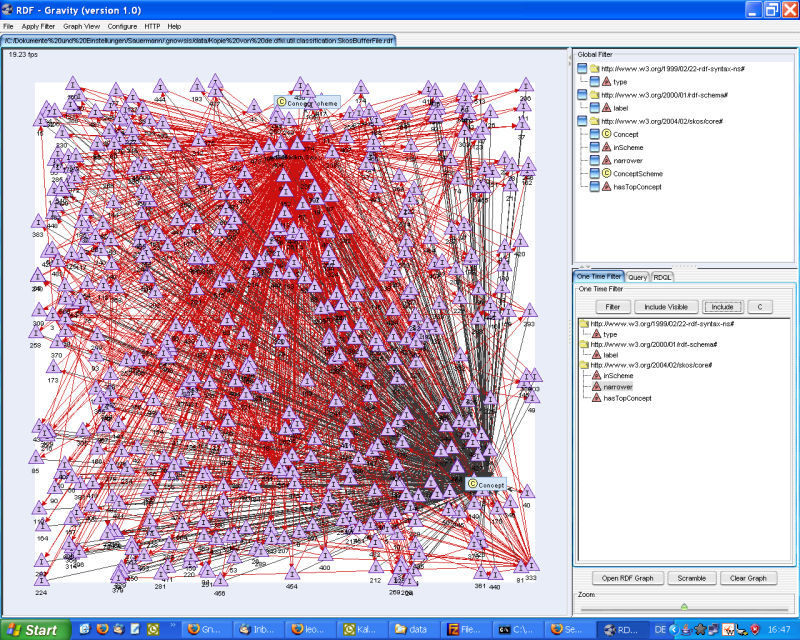
loading my skos, it completely draw pandemonia:

blurp

hm, so perhaps it is true what i said about the general rdf browser is not possible.

cheers Leo

btw:
logged on swig

welle erdferkel getroffen

und es kommt noch besser.

Ich verlief mich im Informatikgebäude an der TU Kaiserslautern, auf dem Weg zum Dekanat eklatant falsch abgebogen und auf die krummen Bahnen der Fachschaft geraten. Gute wahl dachte ich, kann ich gleich nach dem erdferkel vom letzten eintrag suchen.

Gedacht, getan, mal bei der Fachschaft laut in den Raum gerufen “wer ist hier das Erdferkel?”, die antwort war dann “im anderen Raum, der mit dem neuen Mac”. Danke für den Hinweis, im anderen Raum sitzt dann jemand mit einem noch nicht abgekratztem, also neuem, powerbook.

Ich geh hin, frag ihn: “Bist du das Erdferkel?”

er schaut vom Mac auf, denkt nach, schaut mich an, sagt:
“Bist DU der DFKI – ler!??”

im Raum wird spürbar, dass hier mehr passiert als sichtbar ist. blogosphäre eben. Nebenbei hat mir die Literatur des Vorfalls geholfen, die anwesende Hackerin als Anika zu erkennen. Interessant dabei, dass der Frauenanteil der Informatik ja traditionell gering ist, in der Fachschaft aber erfreulicherweise relativ hoch.

answer to Miltiadis

Miltiadis D. Lytras posted questions about how the Semantic Web did in 2004.

in good spirit of public discussion, i hereby blog my answer to his questions.

1. What was the Key achievement for Semantic Web in 2004?
APIs. Forget the scientific glass-tower. Jena 2.0, Redland, Sesame, … that’s what counts and thats what makes things like Julie work. APIs enable developers to make products for people. Products that let people author RDF, publish RDF and use published RDF.

2. Which was the key technological achievement concerning SW for 2004?

Widespread FOAF usage. Even TimBl mentioned FOAF in interviews. That’s ontology work alive.

3. A title of a research paper published in 2004 with great impact
for SW Research.

hm. Nothing real new this year? Well, I quote myself: “Using Semantic Web technologies to build a Semantic Desktop”

4. An event (during 2004) that you evaluated of great importance for
SW.

FOAF Camp, Enschede, Holland. August.

5. A project / project deliverable that you evaluated as of critical importance for SW, in 2004.
http://www.foaf-project.org thats where we come together.


6. Which is the Key obstacle that you anticipate as the ‘battlefield’ for the evolution of SW?

Hot air coming from people that talk about “inference” while there is no widespread data available they can do their inference on. For me it sounds like “inferiour” than inference. Forget inference and OWL, stick to low tech RDF-S and procedural programming to get the SW lift off the ground.

Ontologies written by people that do not code. They are crap. Without a reference implementation, OWL or RDF-S ontologies are useless. You hit the nerve only when you build a useful application that makes its data available in the ontology. Only an application shows how the ontology should be used correctly. See DubliCoren: half of the terms are vague and are used wildly.

URL discussions. Much hot air on RDF-IG about what a URL denotes and why we should use URIs but no solution. As long as some people wait for the “perfect” system that uses unambigous URIs, nothing will be built at all. Gnowsis on the other hand goes the practical way: use changing URLs to identify stuff and begin coding SW today.

btw: there is no inference engine that can work in a global, distributed, semantic web. i.e.

?x <rdf:type> <foaf:Person> 

would take an hour on my machine….

7. A Business case that SW proved its capacity to solve real world problems.
Vendor independent social networking solved by foaf (isntead of orkut, friendster, etc).
News aggregation by RSS. that was real a kicker.


8. How did you saw the AIS SIGSEMIS Activities? What would you like from us the next year?

Peer review. Part of the articles was very simple. I.e. “component requirements for a universal Semantic Web Framework” – without a reference implementation this is rather speculative. We gnawed on this in practice (www.gnowsis.org). So I would like two things:

  • peer review
  • theories proved by reference implementations

Schöpfungsmythos und Gott

Im Hauskreis bei uns in der http://kaiserslautern.feg.de machen wir am 29.11.2004 das Thema Evolution durch. Also den Christlichen Schöpfungsmythos und den Bezug zur Wissenschaft.

Punkte die ich herausarbeiten möchte:

  • Grundaussage von “The Origin of Species”. Mutation, Selektion.
  • Schöpfergott? Ja, gottes wille schafft oder nein, es ist zufalll
  • Bibel Interpretation nach der Bedeutung für unser heutiges Leben? Ja, das ist christlich, Nein, das galt nur für die Leute damals
  • Bibel Interpretation wörtlich nach dem Wortlaut? Ja, jedes Wort ist genauso wie gott diktiert hat und ist wörtlich zu interpretieren. Nein, die Überlieferung ist fehlerhaft, der Text muss auf Entstehung und theologische Aussagen ausgelegt werden.
  • Bibel Interpretation im historischen Kontext-auf welche anderen Schöpfungsmythen (und Grosse-Flut Mythen) bezieht sich Genesis und will ich das wahrhaben?
  • Evolution als Wissenschaft? Ja, Selektion und Mutation. Nein, Gott erzeugte alle Grundarten
  • Evolution als Religion? Ja, man kann aus der Evolutionstherie ethische Werte ableiten. Nein, ethische Werte werden durch Gott und Gesellschaft gegeben.
  • Theistische Evolution – schuf Gott durch Evolution? Ja, Gott steckt hinter all dem. Nein, wer diese dinge verbinden will ist ein Sünder.

Hier eine Linksammlung:

http://www.icr.org/ – Institute for Creation Research, sammelt kreationistische Forschungsergebnisse

http://www.talkorigins.org/ – Sammlung von häufig gestellten Fragen zum Thema, aus der Wissenschaftlichen Seite (gut recherchiert, aber ohne theistischen Hintergrund)

Origin Myths – Artikel über Schöpfungsmythen im allgemeinen

Papst Johannes Paul II über Evolution

Das chaldäische volk kennt auch eine Überschwemmung und einen Noah, nur heisst der anders:

The deluge, according to the Chaldean epic, was due to the judgment of the gods Anu, Bel, and Ninip, and Ea told the “man of Surripak”, Samas-Napiati (the living sun), to build a ship to preserve plants and living beings; it was to be 600 cubits long, and 60 broad and high. Numerous details of the building and construction are given; and Xisuthrus with his people, and animals, and plants, and food had entered the ship, “the waters of dawn arose at daybreak, a black cloud from the horizon of heaven. Rimmon in the midst of it thundered, and Nebo and the wind-god went in front.” The earth was covered, and all living things destroyed. Even the gods were afraid at the whirlwind,and took refuge in the heaven of Anu. After six days and nights the storm abated, and the rain ceased, and the wind and deluge ended. “I watched the sea making a noise, and the whole of mankind were turned to clay, like reeds the corpses floated…In the country of Nizir (east of Assyria) rested the ship; the mountain of Nizir stopped the ship,and to pass over it it was not able…On the seventh day I sent forth a dove, and it left. The dove went, it returned, and a resting-place it did not find, and it came back.” Later a raven was sent forth, and it did not return. Then the ship was opened, the animals came forth, sacrifice was offered to the gods, and Xisuthrus became the father of Izdubar, himself being later translated to live as a god. We cannot attempt a detailed comparison of the Chaldean and Noachian floods, for which reference must be made to Professor Sayce’s edition of Mr. Smith’s “Chaldean Account of Genesis”; but we may remark that this deluge narrative, perhaps more than anything else, shows how closely the narratives in Genesis are related to Chaldean traditions or sources of information.

see: http://www.talkorigins.org/faqs/faq-meritt/flood.html#myths