More on the Semantic Web Congress by Benjamin Nowack

Two weeks ago I gave a talk at ZGDV.
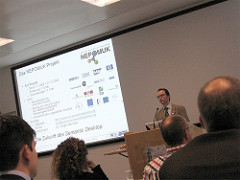
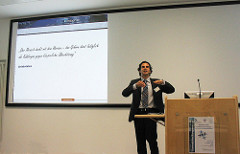
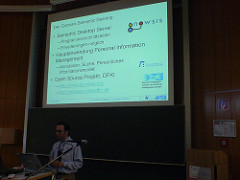
Benjamin Nowack blogged about the ZGDV Semantic Web congress and was so polite to put his slides on the web. Also, he published the nice pictures of me having fun while giving my talk.

I can only copy that behavior and here they are, my slides on Semantic Desktop (in German):
www.dfki.uni-kl.de/~sauermann/2006/10/19/009_sauermann.pdf

I took the freedom to copy them to flickr, not to push his bandwith too much 🙂 here they are:
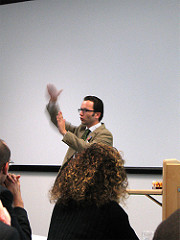
trying to look like Minority Report
Nepomuk slide and Leo

PhD step2: the research question and how can I answer it (is it possible to write a PhD on gnowsis?)

I will be blogging about my Semantic Web PhD for the next months, until I am finished. You will learn what I did in the last years and what I plan to do in the next months to write my thesis. Perhaps you can copy something for your own work or point me to information I missed – critique, positive and negative, is warmly welcome.

The topic of my PhD thesis is derived from my Diploma Thesis “The Gnowsis: Using Semantic Web techonologies to build a Semantic Desktop”. The work I did in 2003 was to create a Semantic Web Server for a single user, on your desktop. So the desktop is turned into a Semantic Desktop. The abstract ends with:
Using the gnowsis prototype, which is a result of this work, applications have access to all important information stored in a single computer. Users are able to classify and structure their information in any way they want by creating bidirectional links between resources. A prototype information management tool GnoGno based on a wiki /weblog was built to explore this possibility.

So, what am I going to do for PhD? Continue! I got different remarks on that by others:

  • That was a diploma thesis? After reading it, I thought it was your PhD
  • Just write down, we will see then…
  • You can never write a thesis about an implementation, thats not science

Note that I worked for 18 months on this diploma thesis, beginning June 2002 and finishing December 2003, which is far more time than any thesis student has here at DFKI, so it may contain enough to be accepted as PhD at some universities in the world. At least, I did publish a description of an implemented Semantic Wiki, a Semantic Blog and a way to extract data from Outlook using find(SPO) queries, using a mapping language like D2RQ. All these topics are still very hot, years after my work. Also, I published them piece by piece in peer-reviewed conferences or journals. Nothing to hide there.

So, I am positive that my work is science. Coincidence, I googled for websites that are like mine today, stumbling across Dennis Quan. His thesis made with David Karger at MIT on Designing End User Information Environments Built on Semistructured Data Models is a good example of the direction I want to go: describing how to build Semantic Web environments for the real world. And I interpret Dennis’ thesis in a way that you indeed can write a PhD thesis about implementation matters, half his thesis is about Adenine, Ozone and the RDF bits and pieces he created (which are very good, btw).

So the research question I have is on the borders between Semantic Web, Artificial Intelligence, and Knowledge Management:

If Personal Information Management is the main use of Personal Computers, why is then not part of the Operating System of the computers? Why does it only handle files and folders, and not Persons, Projects and Topics?

We need a system int he spirit of the memex – a personal extension of the brain. A system then be used to write down notes in a “new” way. My diploma thesis ended with the idea that Users are able to classify and structure their information in any way they want by creating bidirectional links between resources. But “Any Way” has to be specified further. We miss an answer to: how to write down information the best way, on a Semantic Desktop?

So my PhD will contain a roundtrip on the Semantic Desktop – the idea of a central server and applications around it – and then go into the Personal Information Model (PIMO) we use to manage information. At the end, I will shine light how to automatically generate the PIMO, something that is addressed a lot in our group.

The way to answer these questions and challenges is (for me) clear: Personal Information Management cannot be handled by a single applaction like MindManager of Microsoft Outlook. It has to include all information items that come into our attention during every day, it has to include my web-browsing, my e-mails, my project management tools, my co-workers, my employees and students, my project and my tasks there, my SVN commits, my papers, travel to conferences, giving talks, powerpoints, blog posts.

So it has to include all the applications in this chain: blogging, flickr, powerpoint, e-mail, MS-Word, etc etc. And what we did in gnowsis and the EPOS project, was to look that all these applications can be enhanced with plugins so that they can capture the information behind. What we need is a unified tagging scheme for each person, a “personal Technorati”. If I use the tag “burning man 2006” in delicious, I will also use it on flickr, and on my e-mails. so simple – I am always the same person, so independent of application, my PIMO is the same. Simple in theory, tricky in practice.

practice will follow.
Presentation of Nepomuk at Thales

I visited Jean Rohmer, working at Thales in Paris, to present Nepomuk and related ideas on the social semantic desktop.

Jean is an AI veteran in France, working at Bull computers and within his own company before, and is now employed by Thales to work on Ideliance, a Semantic Desktop. They sell it primarily to government and military customers, these are the primary Thales customers.

My presentation included the basics of my work, the current Nepomuk goals, and a few examples taken from the Gnowsis project.

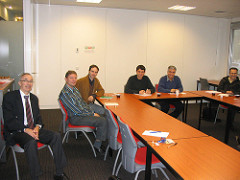
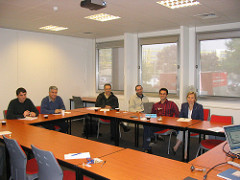
Here are pictures of the audience:
Audience of this Semantic Desktop talk
The audience of this Semantic Desktop talk

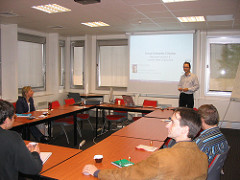
And me presenting:
Leo

The presentation can be downloaded here:
gnowsis_nepomuk.pdfpdf

I used the same outline I have been using since 2003, but unlike the last years, I found that one of the sentences from my 2003 presentations was missing: “if PIM is the main use of a PC –why is it not defined in the operating system?”

This is a central motivator for my work: making a Semantic Web layer on the desktop, that allows managing your files as easy as web resources, but with Sematic Web coolness. Meaning, your computer knows of people, projects, places, topics, and not only of files.

Nepomuk Meeting in Paris: User interfaces

Last week we had several Nepomuk related meetings in Paris, one I attended myself. The Nepoverse came together to discuss user interface related things.

Yngve Sundblad and Bosse Westerlund from the HCI group at CSC from the Stockholm university were there, with their staff Rosa, Kikki, Sinna, Henrik and Christian, and more I think..

They presented our current state and many prototypes they did, mostly video prototypes. Also they start to identify features, we gave priorities to them and had to work on the ideas.

For example, this is such a user interface idea:
design idea for nepomk
This is a still photograph of a video presentation, you will see the results of this interface in about a year in the open source implementations.

During the meeting, we:

* read e-mails
Meeting

* watched presentations
Meeting

and worked on prototypes. This point I did not photograph, because I had to work.

We also had dinner together, here are some pictures:
Dinner

dinner

Dinner

Alltogether a good meeting on the social semantic desktop features, we worked for three days, some people also had meetings before and after.

iTunes gone wrong

I put a newly bought audio-cd “Dendemann-Die Pfütze des Eisbergs” into my iBook drive, to listen and rip it with iTunes. That is the main application of iTunes – right?

What happens:

  • iTunes blocks and then hangs and fucks up. Great!
  • ok, pressing F12 (the key to eject cd on iBooks) does nothing. So it fucked up the OS
  • closing iTunes via alt+apple-esc (=ctrlaltdelete). cd still eaten
  • ok, this machine is stuck, I’ll reboot and blog on then…
  • oh! rebooting doesn’t work because the f*** cd driver seems to be hacked directly to the kernel or however they did it, I had to hard-reset the machine (basically, pulling the power chord)

So, after rebooting I wisely

  • close iTunes
  • put in the CD
  • wait till this event of putting the CD in the slot starts iTunes, then
  • iTunes asks me if I want to rip this CD, which I want
  • and then it works

great! everythings so easy today.

R U serious I have to ask – or are you intentionally f***** it up so that I have to buy the music at the iTunes music store? (which is ok, but then I suddenly think about Audiograbber and Winamp…)

iconography gone astray

whats that icon about?

iconography gone wrong - wo bitte gehts zum rechteck mit kreisen....

The one to the right. You surely know, or have a great idea what courageous people will find at the end of this road…

click picture, comment there!

Talking about Semantic Desktop at ZGDV’s Congress

Today I gave a talk in Darmstadt’s ZGDV Institute, at the 3rd Semantic Web Congress. Hugo Kopanitsak organizes these events and managed to get an interesting round of speakers for this event.

Update: slides are for download here, Benjamin Nowack inspired me to put them online, thx.

Here is the homepage:
http://www.zgdv.de/zgdv/zgdv/Seminar/Darmstadt/Kongresse/3_SemWeb

I gave a talk about Semantic Desktop, and as I was the last speaker, I tried to keep it short because all of the previous speakers managed to sum up some minutes of delay.

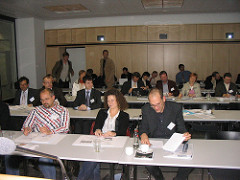
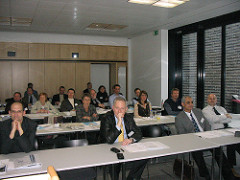
The audience was filled with people from industry and government, hungry for Semantic Web. Here are two pictures of my audience:
my audience
my audience

And here is Hans-Peter Schnurr from Ontoprise, a picture I had to “gimp” up a little (a coffe cup was to the lower left and the light had to be corrected for the beamer vs Hans-Peter, luckily Sven Schwarz taught me how to do this on The Great Escape :-).
Hans-Peter Schnurr

And Benjamin Nowack
Benjamin Nowack

Benjamin made more pics of my talk with his digicam, we will probably see them soon.

gave a talk on Semantic Desktop for e-learning, and another tomorrow

yesterday I gave a talk on Semantic Desktop in e-learning scenarios.
At the “e-learning day der TU Kaiserslautern”

It was a short presentation and a little demo, and although I have a cold, Martin Memmel said it was a good talk. That was a nice thing to hear, because I never know if my talks are good or not. What kind of quality function can you use anyway?

He also made this photo of me:
Giving a talk

Tomorrow I will give a talk on Semantic Desktop as such at a Semantic Web Congress at Darmstadt’s ZGDV, and I am looking forward to do this because the other presenters are quite famous. One hacker you might know is Benjamin Nowack, others are CEOs of SemWeb companies in Germany like Hans-Peter Schnurr or Holger Rath, and there are many interesting speakers about applied Semantic Web.

semwebzgdv

http://www.zgdv.de/zgdv/zgdv/Seminar/Darmstadt/Kongresse/3_SemWeb

Semantic Web Client Library

Recently I found the problem of embedding “dynamic” data from the semantic web to the semantic desktop, namely data that cannot be crawled efficiently.

Also, to annotate web resources in gnowsis, it is good to know as much about them as possible. A key to this vision is to respect the current best practices of publishing RDF data. Luckily Tim Berners-Lee has concentrated them alltogether in Tabulator.

And for us, we can use this by building on a library that the witty Chris Bizer, Tobias Gauß, and Richard Cyganiak did:

The Semantic Web Client Library

sites.wiwiss.fu-berlin.de/suhl/bizer/ng4j/semwebclient/

The Sematic Web Client Library represents the complete Semantic Web as a single RDF graph. The library enables applications to query this global graph using SPARQL- and find(SPO) queries. To answer queries, the library dynamically retrieves information from the Semantic Web by dereferencing HTTP URIs and by following rdfs:seeAlso links. The library is written in Java and is based on the Jena framework.